Wednesday, July 1, 2020

Sewing Tutorial: Mermaid, Whale, or Shark Tail

Mermaid, whale, or shark tail blankets/sleeping bag sort of things are widely available to buy ready-made in stores, but they're also not difficult to make at home. Here are the steps I followed to sew a trio of customized mermaid tails.


It's hard to find "panda unicorns in space" mermaid tails in stores.
SUPPLIES

Fleece fabric 
Cotton quilting fabric
Waistband elastic

The amounts you need will vary based on the size you're making--I used less than a yard of fleece for one child who wears a size 3 or 4T, and closer to one and a half yards for the two who wear sizes 8 and 10/12; less than a quarter yard of cotton for each, and one two-yard package of waistband elastic between the three. I've tried making tails with different elastics and with separate fabric for the fin parts, but I find this way works best.
MEASUREMENTS


You'll need to take six measurements:

1: total height
2: armpit to toes
3: around torso with arms at sides
4: around ankles with feet should-width apart
5: over the shoulder (for straps)
6: across chest (armpit to armpit)
These are the measurements for my child who wears a size 8
Next, you need to adjust some of the measurements a bit for the pattern. This is for seam allowance, and to be sure the tail isn't too tight. The tail is made in two halves, so you also need to divide the third and fourth measurements in half, as I did in the picture above.
1: subtract 4-5 inches (10- 13 cm)
2: no adjustment
3: add 2 inches (5 cm); divide by two
4: add 2-3 inches (5-8 cm); divide by two
5: add 1 inch (2.5 cm)
6: no adjustment

CUTTING THE MATERIAL

You will be cutting two identical pieces of fleece, two identical strips of cotton (or one long one cut in half), and two pieces of waistband elastic.

For the fleece, cut two rectangles the length of Measurement 1 by the length of Measurement 3.


In this example, 45 inches long and 18 inches wide.
Mark the center of the the short ends of the rectangle. From there, mark the spot the length of Measurement 2 from one short edge: this second mark will be where the tail starts, and the narrowest part of the tail. Center Measurement 4 on this second mark, and cut a diagonal line to shape the tail. Do the same on the other side. 
Here, the left side is 18 inches wide, tapering down to 11.5 inches wide over 36 inches.
There is still room on the right to cut the fin shape.
With the fabric remaining past the narrowest part, cut a fin shape.
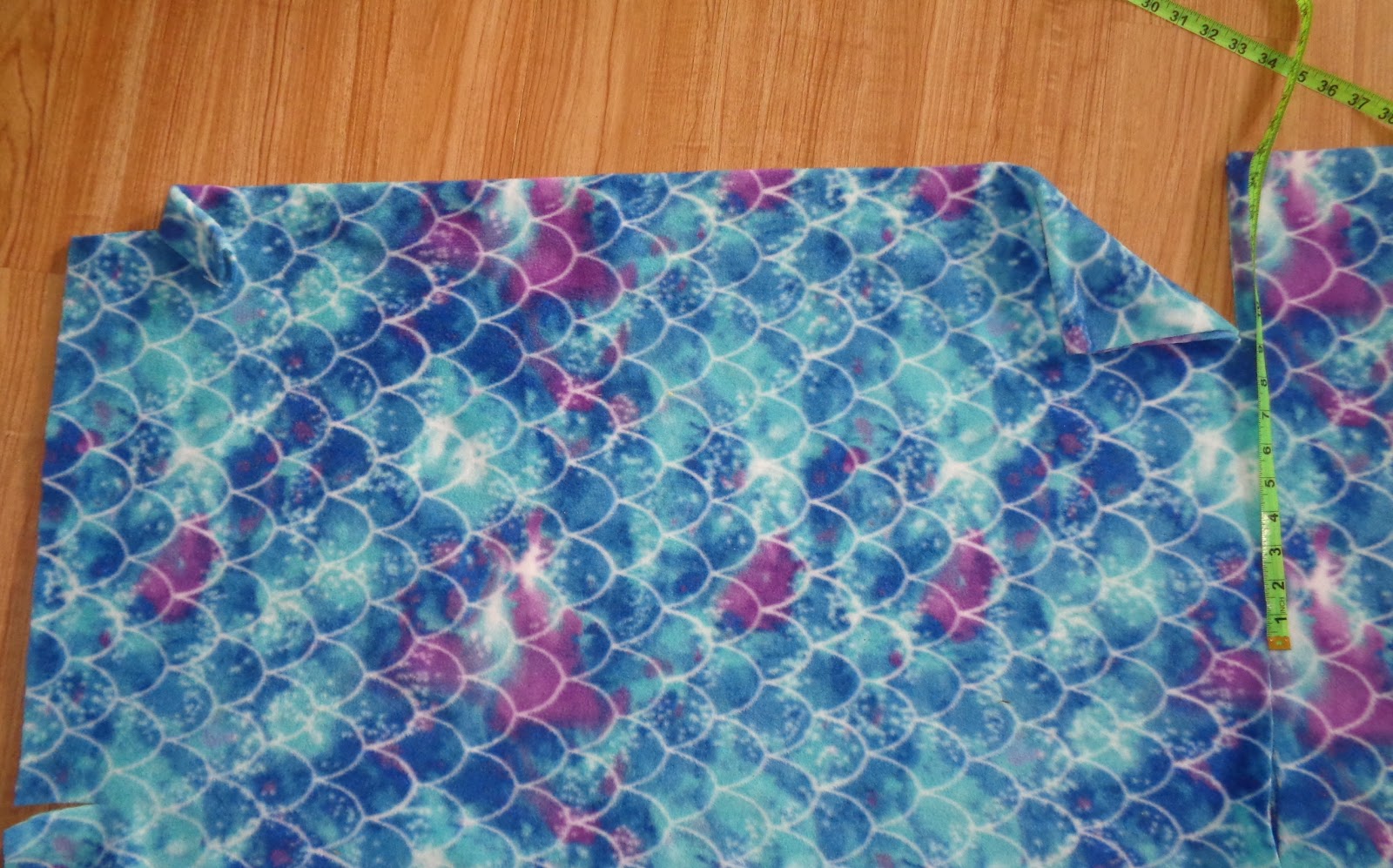
Looking more a like a tail now!
The next two pieces are much simpler. Cut two pieces of cotton quilting fabric six inches (15 cm) wide by the length of Measurement 3. Fold the strips in half (i.e.; 3 inches/7.5cm wide), wrong sides together, and iron. These will be used similar to quilt binding.
Six inches by 18 inches for this tail
Finally, cut two strips of waistband elastic for the straps, using Measurement 5. 
Time to start sewing!

CONSTRUCTION

You'll start by attaching the straps and the cotton to the top of one piece of the fleece--that is, the end opposite the tail fins. Mark the center of the top side, and pin the straps on the wrong side of the fleece, according to Measurement 6. If your waistband elastic has a right side and wrong side like mine does, be sure the wrong sides of the elastic is facing the wrong side of the fleece.
The outer edges are 8 inches apart for this size tail.
Arranged this way, the black side will show--
I ended up changing it around for the silver to show.
Next, position the cotton strips. The cut edges will match up with edges of the top of the tail and the ends of the elastic. Sew these three layers into place.
Fleece wrong side up, elastic wrong side down, cotton with raw edge where the WonderClips are
Again, I actually flipped the elastic, as shown in the picture below.
My needle is in the middle position.
Just like you would do with quilt binding, bring the cotton over to the right side of the fleece. The straps will be sticking out between the fleece and the cotton. Sew the cotton down, both at the top of the tail and at the folded edge.
You could just sew a hem along the top of the tail and attache the straps within the hem,
but I think this looks nicer, and is a sturdier.
That's one side done--now the other one. It's pretty much the same process, except you need to be mindful of the half of the tail attached to the other ends of the straps. Be careful!
Once you're sure the straps aren't twisted, sew them and the cotton on like on the first half.
You should end up with your two tail halves set up like this. If you're making a shark or other fish tail, please be aware that this will make the tail "sideways" from how the animals actually look, as their tail fins are vertical compared to their bodies while whales and dolphins have horizontal tails. This might not matter to you, but it might be important for the child you're sewing for. To correct this, you would attach both ends of the same strap to the same half of the tail. It would also make it easy to add a dorsal fin to the seam that will end up along the child's back.
In retrospect, I should have moved the needle all the way to the left when I sewed the folded edges.
Now it gets easier again: pin (or clip) the two halves right sides together, and sew around the perimeter--except for across the top, of course! You can overcast the raw edges if you want to, but with fleece it's not necessary. It comes to whether you want a bulky seam or a raw seam.
I used a narrow zig-zag, and left the edges raw.
Turn it right-side-out and cut any errant threads, and you're done!

Ready for a movie night.


Monday, June 15, 2020

Gifts for: Getting Well

When someone is sick or injured, it's natural to want to help. Here are some ideas:

FOOD

Someone who's recovering is going to be exhausted, physically and mentally. Having food on hand helps people remember to eat. A variety of foods that can be frozen and eaten readily help both the person recovering and anyone helping.
Soups, quiches, casseroles, cookies, and snacks like sausage rolls all freeze well--these kept my parents fed for several days following a medical procedure, so the one who had it could rest and the one who didn't could take care of other things around the house, and both had more time to relax.

As with any gift of food, be aware of allergies, intolerances, cultural and religious taboos, and other dietary restrictions. Try to deliver the food in packaging that doesn't need to be returned to you, like bags, foil, or cheap containers. Have the food cooked if possible (in the picture above, the minestrone soup is cooked but the noodles are still raw, so they don't fall apart before the soup is eaten) and ready for the freezer, with instructions on reheating. Include an ingredient list as well, as some foods interact with medications you might not know the recipient is taking. Consider including utensils and napkins as well. Maybe some flowers, too!

Of course, you don't have to do it all yourself. You might want to organize a meal train, where several people coordinate days to drop off food. Often a person's co-workers, friends, or fellow members of a religious community are happy to help.

And the food needn't be homemade. It might not be practical to try to send homemade food over long distances. When a relative had a baby in the NICU several states away, I wasn't able to mail a lasagna. What I could do was call a few local food delivery places and pay for gift cards to be sent to my family, so they could focus on the new baby (who is now doing great) instead of trying to figure out what to have for dinner. Another time, I signed up for a day on a meal train for a church member with a new baby, and ordered pizza for my night. The pizza parlor had no issue delivering to an address different than that of the person paying for it, and I included a delivery tip in my payment (and told the family I had).

HOUSEHOLD HELP

Everyone has at least one housekeeping task they dread, whether it's dusting or laundry or dishes or something else. If you're close enough to visit during someone's convalescence, offer to help with a task. Be specific: "Let me sweep so you can rest" instead of "Can I do anything?" It's easier to agree to a specific task than think of one. Especially for a long recovery, you can ask if anything's due soon, like a car's oil change.

If you're not close, you can also offer to hire a maid service or to pay for a neighbor to mow the lawn. Some hairdressers and beauticians even offer in-home appointments!

You can even help by proxy. At the moment, I can't visit my grandparents to help with anything directly because of COVID19 concerns, and because of their age, they're supposed to stay home as much as possible. But my next-door neighbor is about their age, and her family can't visit for the same reason. Instead of bringing my grandparents food, I've taken a few meals and some flowers to my neighbor and started taking her waste cans to and from the curb on trash pick up days, and my grandparents' neighbors have checked on them. My grandparents like to hear that I'm looking out for the people around me, and I appreciate those who have helped my grandparents.

SHOW YOU CARE: BE THERE

While neither my neighbor nor my grandparents are sick (thank God), they have felt cut off with the lockdown orders. I can't visit in person, but I can make more of an effort to call and send pictures and letters through email and regular mail. When people are at home for a long time, it's very helpful for them to know the world hasn't left them behind.

In normal circumstances, you can visit a person in the hospital, recovery center, or at home to relieve boredom and provide face-to-face interaction. Even if there's no housework to do or meals needed, a visit can lift spirits.

COMBAT BOREDOM

Depending on the illness or injury, recovery can be long and boring. One of my friends was on bedrest when she was pregnant...for weeks. She felt fine, but had to be in the hospital to keep her twins safe. The hospital staff was excellent to her, but she was far from the only patient, so she craved visits. Another friend had a long recovery at home following knee surgery, so I sent her some puzzles and crossword books. When an out-of-state cousin had a stroke and was ordered home to rest, I mailed her several books in her favorite genre, coloring books for her two children, and snacks for everyone.

RELIEVE THE BURDEN...DON'T BE ONE

Recovery can be hard. The body needs resources to heal, and physical, occupational, and other therapies are exhausting. Some people really like their alone time! When visiting, keep in mind that a person might tire more easily, and be ready to cut your visit short. If you visit someone in a hospital or nursing home, check with a staff member first to be sure the person is ready to receive visitors. If visiting someone at home, be prepared to be told that it's not a good day for a visit. You can be frustrated at the situation, just don't take it out on anyone. Also, trust the person's doctors. This is not the time for quack remedies or empty platitudes--it's one thing to send a thoughtful card with the promise to pray for someone, it's another to blame a person's malady on lack of faith. Be careful not to give gifts that require a lot of energy to use, and don't expect to be waited on. You want to be the one helping!

Monday, June 1, 2020

Gift Espionage: Making Sure it's Perfect

You have an idea for a great gift, but you need some information from the recipient. How can you find out without giving away your surprise?

GET PEOPLE TALKING

Most people talk about themselves easily. Want to be sure the socks you knit will be the right size? When I wanted to knit a pair for a co-worker, I complimented her shoes by saying, "Those look so cool! Do you know if they come in size 10s [my size]?" Just as I'd hoped, she responded, "I don't know...these are 7s." She told me where she bought them so I could find out, but I'd already found out what I wanted: her shoe size.

Most people also like to give advice. Be subtle. Recently, I wanted to buy my husband a dashcam. He'd mentioned wanting one, but I knew he'd want certain specifications. So I asked my brother to pretend he was in the market for a dashcam and ask my husband which one was best. My brother reported back to me, and I knew what kind to get.

Look for openings to ask leading questions, but try to not be too obvious. You don't want to make your recipient feel uncomfortable.

ENLIST HELP

You can often get in touch with a person's parents, siblings, or roommates to find out clothing and shoe sizes, and whether they already have the latest book in a series or a subscription to a particular service. This is also a great way to check for allergies, intolerances, and other reasons that your idea won't fit as well as you thought. 

Do be sure to specify that you're looking for gift ideas--maybe the person helping you will think your idea is perfect and get a duplicate!

CHECK ONLINE

Does your recipient have an online presence? Check out Facebook, Instagram, Pinterest, and other profiles to glean information on favorite colors, books, movies, brands, foods, and styles. Some people even belong to online gift exchange groups, and keep up a list of ideas for them.

MAYBE...SKIP THE SURPRISE

If you really need to know specific information and can't find out through other channels, you'll need to either get a different gift or go directly to the source. It's not a GOOD surprise if the gift ends up something the recipient can't use.

For my dad's last birthday, one of my brothers suggested a ladder. Dad had seen my brother's and commented that he should replace his with the same kind...just as he said to my other brother, and to me, when saw each of our ladders--newer and more versatile than his. I first called our mom to confirm that Dad hadn't already bought himself a ladder in the past few months. He hadn't, so we agreed  ladder was the way to go. Then my other brother found a fantastic sale; the ladder was discounted from $170 to $95. But it was a foot shorter than the model my brothers and I have... I put in another call to Mom, but she wasn't sure the height of Dad's current ladder or how tall he needed it to be. The sale only lasted another day, so my brothers and I decided that since we couldn't really wrap a ladder anyway, we'd just tell him what we were getting him and make sure we got the right size. It would do no good to save money on a ladder that he couldn't use. The shorter ladder DID turn out to be tall enough for what he needed, and we were able to take advantage of the sale (and the free delivery), and most importantly, Dad was happy with his gift: something he needed and wanted, but couldn't justify getting for himself.

Friday, May 15, 2020

Gifts for: Saying Goodbye

What do you do when someone is leaving for somewhere far away? How can you encourage your relationship to survive the distance? If you want to encourage keeping in touch, you can give...

SOMETHING TO REMEMBER ME BY

We live in a city with military base: people come and go often. When a classmate of my daughter was preparing for a move across the country and sad about missing her friends, I was able to get the teacher to help with a going-away present: the teacher took a picture of the class, emailed it to me so I could print it, and I put it in a wooden frame found cheap at a second-hand store so the class could sign it.

Pictures and cards are good mementos, and easy to pack. For someone you're especially close to, you might be able to make or find something to recall a special time you had together, or a joke you share. 

As long as it's not too difficult to pack, maybe you can send along something your area is known for: specialty foods (that won't spoil before they can be used), artwork (that will stay intact), plants (that aren't invasive), or other memories of a former home.

HELP FOR THE JOURNEY

The person who's leaving likely has a long way to go, be it by plane, train, car, boat, or some combination. Money or gift cards for gas, food, and lodging along the way are sure to be helpful. You could make a playlist of songs that are important to the two of you, or buy or make activity books keep the recipient (or the recipient's travel companions, especially young ones) occupied. If the trip includes travel to a foreign country, your recipient might like foreign currency or maybe a handmade or storebought pouch to hold a passport and other travel documents.

WELCOME TO YOUR NEW HOME

Do you know your recipient's new address, and can you time mail to be there on moving-in day? If not then, maybe a week later--perhaps with gift cards to local places or guides to the new area. Many cities are willing to mail brochures from the chamber of commerce, and companies like AAA are also a wealth of information on where to get started in new places. For foreign countries, a bit of cash in the local currency can be very helpful; you can get this at most banks (although it can take up to a few weeks).

Not everyone will want to advertise that they're new in town, so don't go signing people up for welcome services or registering them at local clubs. Instead, give your recipient the information and leave the decision to the one who will be affected by it.

STAYING IN TOUCH

Don't let "out of sight, out of mind" be true. If you see something that reminds you of the person who moved away, text a quick picture. If an annual event you used to attend together rolls around, maybe send a souvenir or postcard of it. 

You can make it easy for your far-flung recipient to stay in touch, too. When another classmate moved away, my daughter's class sent her off with a stack of stamped cards addressed to their classroom (and a few blank ones) so she was able to write to them from time to time. 

Moving far away is a big step, and you want to make it easy on those who undertake it while letting them know that distance is something easily overcome by friendship.

Friday, May 1, 2020

Buying Gifts Online: Tips and Resources

The internet is a great resource for obscure items. With so many website selling handmade or secondhand items, it's easier than ever to find just the right gift. Here are some ways to make it easier:

TIMING

Almost anything ordered online will need to be mailed to you or the recipient, with the exception of things like gift cards, email greeting cards, and intangible items you can print or email proof of. Any number of things can delay shipping, especially if you order from another country. Order with plenty of time to spare and you'll not only give yourself a generous cushion for the unexpected, you'll avoid premium fees for expedited shipping. It also gives you time to be sure the gift isn't damaged, especially if it's secondhand (for example, you'll be able to watch a used DVD to be sure it plays correctly).

For bigger items, order when you'll be home during the delivery window. You don't want a big package sitting outside your door when you're on vacation, so unless someone is collecting or holding your mail for you, be careful of when the gift will arrive.

If you're having the gift sent directly to the recipient, consider whether you want options like gift wrapping or having the price hidden. Not every service will offer this. Make sure the recipient isn't heading out of town when the gift will be delivered.

SAVING MONEY

There are a number of websites that help you save money when ordering online. For discount codes and coupons, check sites like RetailMeNot or NaughtyCodes. Both let you enter the name of the site you're ordering from to check what current deals and coupons are available. You can also often get a discount for your first order from an online store if you create an account or sign up for a newsletter. Deals vary from a free item to a percentage off your first purchase.

There are also browser extensions you can use that automatically look for discount codes when you're shopping online. My two favorite are Honey and Wikibuy. Both show me options for deals when I'm on the checkout page of an online store, and both also store small amounts of points from purchases that I can redeem for gift cards.

You can also track the prices of specific items to see when the lowest prices and buy when the price drops to what you'd prefer to pay. Wikibuy does this, as well as Keepa and CamelCamelCamel, the latter two specifically for Amazon products.

CAVEAT EMPTOR

Be wary of deals that seem too good to be true. If an item is being sold for a fraction of its usual price, especially from a far away country or secondhand, it might not be what you're looking for or it might be broken. If the seller says up front the item will take longer to arrive than the charge dispute window for how you're paying, be careful. For example, you have 180 days to charge a dispute on Paypal. Six months should be plenty of time to get even a custom handmade item, so something that will take longer than that to arrive is a huge red flag.

Make sure you're really getting what you think you are. Read the product description. Are you getting a finished blanket, or the instructions for making one yourself? Is it a full-length mirror, or a handheld one? The book you wanted, or the movie adapted from the book? The soundtrack to that movie? (Fortunately, when that happened to me, it was just something I'd put on hold at the library)

If you're boycotting a particular company or product, you can do some internet research to be sure your gift won't accidentally support something you or the recipient detest. Buycott is a great website to check potential purchases. You can also use it to check items you might want to buy in person.

The internet is vast and you can find the perfect unique gift on it. Just be sure it will arrive on time, intact, for the best price, and that it's something you'll be happy giving.

Wednesday, April 15, 2020

Gifts for Religious and Cultural Rites of Passage

As is probably obvious, I have much more experience with Christian rites of passage than those of other religions or cultures. If I've made mistakes, please let me know.

There is a huge variety of rites of passage in many religions and cultures. What makes for an appropriate gift is going to be dictated by that religion or culture, as well as the age of the person. A baby having his bris is going to get different gifts than a teenage girl having a quinceañera, who in turn wouldn't be getting gifts appropriate for an adult man being ordained into the priesthood. Especially if you're not from the same background as the person celebrating the rite of passage, do your research. For example, a Bible is a reasonable gift for a Christian rite of passage, but there are different versions and translations, and some are more appropriate for one denomination than for another. 

The key to giving a gift directly related to the specific rite is to find something that will continue the recipient's journey. For example, when one of my children celebrate First Communion, she got a beautiful missal (a book that aids in following and understanding our church services) from one of her godparents. It's a keepsake she'll be able to use for decades. 

Of course, especially with non-perishable gifts, you have to consider the recipient's position in life, and age. A missal would have been hopelessly redundant for my cousin when he was ordained a priest in his thirties--not only does he already have his own, he'll be able to use the ones at any church he serves. But a set of towels that my mom embroidered with his initials for when he moved into a rectory shared with two other priests? Practical and thoughtful.

Children's versions of holy books are popular gifts for childhood rites of passage, and can be very well-received: more than three decades later, I still have the children's Bible my godparents gave me at my baptism. For younger children or babies, there are also many toy versions of various religious objects. Provided they wouldn't be considered sacrilegious (some religions don't allow art depictions of deities or religious founders; for those that don't such a restriction, religious art like icons are wonderful), many parents will be happy to have these tools to help their children learn about their faith on their level.

For teenage rites of passage, older gifts are more appropriate. Though the person may as young as twelve, these rites indicate a person's adult decision to live according to the particular beliefs. In-depth books about the history of the specific culture or religion are a great idea, or other ways to broaden and encourage the person's journey. When people enter a new religion or culture as an adult convert, similar consideration should apply.

If you're concerned that your recipient may become too overburdened with things, especially if the rite of passage includes a long-distance move, a heartfelt card can be perfect. Food is is another wonderful gift--with a rite of passage, be sure to take extra caution that you aren't using any ingredients forbidden by that particular culture or religion! 


Bonus points if the food is related to the occasion:
these dove cookies were for the baptism of a pre-teen family friend

Some rites of passage might require a person to abstain from material goods or wealth. If religious in nature, a promise to pray, light a candle, offer a mass, or other invocation particular to the religion should be appreciated. Another idea is to donate to the person's cause as allowed by the group's rules--for example, in-kind donations like food might be allowed but direct gifts of money might not. In general, if you have any doubts, ask if the gift is appropriate. When you're giving a gift to support someone through a rite of passage, it's more important that you respect the recipient's beliefs than that the recipient is surprised by the gift.

If you're uncomfortable giving a gift specifically tied to religious or cultural significance, or even if you know the recipient well enough to have an outside-the-box-idea, there's no rule that you have to give a "traditional" gift. When my first godchild was baptized at six months old, I knew she already had a children's Bible, and that her grandfather who's a deacon was likely to give her any religious item you could name. I also knew that she was fascinated by looking at patterns of swirls and dots, so I gave her a framed print of Van Gogh's Starry Night. It was hung in her room right away. 

And when her grandfather (my uncle) was ordained as a deacon, I baked him some of the bread his grandmother used to make--in the course of his study, my uncle had amassed and read more religious books than I could count, and he already had many sentimental religious items. The bread wouldn't take up space in his home for more than a few days.

The bottom line is that you want your gift to show that you're excited the recipient is entering the next phase of their journey through life. Whether you find a way to show that through attending the ceremony, finding or making the perfect thing to help them with that journey, or know just what will make them happy on that special day, you're saying you acknowledge the importance and the impact of the rite, and that you care.

Wednesday, April 1, 2020

Gifts for Collectors

At first glance, it seems like it would be easy to pick a gift for a collector. But collecting can be specific, so you'll need to communicate with your recipient or have an inside source.

Many collections need to be stored specifically--shadow boxes, coin holders, protective cases. If you know a specific container is needed, you can pick one up. If you're not sure what kind is best, a gift card to a store that sells them is better. You might also consider special lighting to display the collection, if needed.

A lot of collections have various guides and books that go along with them. If you know the collector doesn't already have them, they're a good option.

Some items are best collected at conventions. You might be able to sponsor all or part of a trip to one, or a day pass. If the location makes it possible, you could go along too and let the collector get to experience the fun with a friend. 

If you know a collector is after specific items that are hard to find and you see an opportunity, jump on it. Worst case scenario is that the collector found one in the meantime and either loves having a back up or you can sell it again. Just be sure it is the right item--maybe the postage stamp is only good if it's unused or the action figure if it's unopened or from a particular production line, for example. Be warned though that some of these items are very expensive. Certain coins that numismatists might be seeking are hundreds of dollars.

If the collection centers around popular culture, you might be able to get relevant autographs. An internet search for a particular actor or author or artist can reveal a PO box or agent's address for sending fan mail. If you mail a nice letter and include stamps and a return envelope, it's possible you'll get an autograph sent back to you. It won't always work and can take a few months, especially if you're requesting an autograph from someone in another country. It's worth a shot, though.