Showing posts with label Household. Show all posts

Wednesday, December 1, 2021

Sewing Tutorial: Charming Hot/Cold Pack

 Here's another project to use up charm squares: a simple pouch filled with rice or similar grains that can be used as an icepack or heated and used at a hot pack.

The red and panda packs are six charm squares each; the blue one is eight with the "extra" two squares cut in half and sewn in between the full-size squares.
SUPPLIES

Six to eight charm squares
Rice, fennel, or other grain--about half a cup per section
I used rice for this one, and fennel for the others pictured above

DIRECTIONS

Sew the charm squares for each side together into a strip. You should have two strips of equal length when you're done.
One strip done, one nearly there.
Put the strips right sides together, and sewn around the perimeter. Leave room for turning--this will also be how you put the grain in.
Turn right side out when you're done.
Now, pour about half a cup of grain into the pouch, and work them down into the far end, opposite where you left the opening for turning. You'll be sewing the first section closed next, so don't overfill it--needles don't like going over hard grains, and will revolt by breaking.
You'll also be top stitching around the perimeter. Don't overfill!
With the grains between two charm squares, sew along the seam between the two charm squares (or wherever you've decided to close off the first section).
See how the section is loosely filled? This is about how it should look.
Repeat for the remaining sections. Finally, top stitch around the edge, taking care to close the opening. Now it's ready to soothe an ache!

Friday, October 1, 2021

Sewing Tutorial: Charming Trivet

 Have a pack of charm squares and need a project? Here's a way to use six of them to make a little trivet to protect tabletops from hot serving pans.


Three charm squares per side


SUPPLIES

6 charm squares
Batting
Insul-brite
Cutting tools: ruler, rotary cutter, cutting board, and iron

For this trivet, I have two sets of three matching squares

DIRECTIONS

Cut four of the charm squares in half diagonally, making eight right triangles.

One side will have the US flag in the center with the stars on the edge,
and the other the reverse
Now cut the triangles to fit against the uncut charm square: center the right angle on your cutting mat and trim so that the hypotenuse (opposite the right angle) is five inches long. You'll be cutting about an inch off the smaller angles of the triangles.

Does that make sense? Like in the picture.
And cut half an inch off the hypotenuse. Repeat these steps for all eight triangles.
Three inches tall, five inches long at the widest part
    
Now sew four triangles to each side of the two remaining charm squares, right sides together.

I have my needle in the default position, and the fabric lined up with the foot.
Iron both sides flat.

And of course, square up the sides if needed.
Layer the two pieces with the batting and Insul-brite: both pieces of fabric right sides together, then batting, then Insul-brite.
Or Insul-brite then batting; doesn't matter
Stitch around the edges, leaving room for turning. Flip right side out, iron, then top stitch.
Stitch along the seams too; it holds the layers together better and looks nice.

Trim any loose threads, give it another press, and you're all set!

Tuesday, June 1, 2021

Gifts for Gardeners

If there's someone in your life you want to give a gift to who enjoys gardening, catering to that hobby is a great starting point. Some things to consider when picking a gift:

How big is the garden? Some are spread out over a person's entire property, some are in a side yard, and some are grown in containers on porches or countertops. All gardeners need to water their plants, but the size of the garden will mean that a watering can is better for some and long soaker hoses and sprinklers are better for others. Just about everyone with an outdoor garden could use sun protection. Many people will find gardening gloves and knee pads useful, but smaller or established gardens are less likely to need trowels and shovels. Gardens that take up only part of a yard are easier to maintain and look nicer with clear garden borders or even raised beds--talk with your recipient to see if those would make good gifts. People with container gardens have less space to work with, so new plants and seeds might not be as welcome, but perhaps some more containers are needed for new plants or ones that have outgrown their current containers. Terra cotta pots are nice for this: you can paint them to customize them for your recipient. Larger gardens can be time-consuming to care for--maybe the owners would like an automated watering system, or even just help and company while weeding. If there's room for more plants in any size garden, perhaps look for "fancy" ones like heirloom varieties or strains of flowers with especially striking patterns like galaxy petunias.

What is the garden for? For food, for relaxation, for landscaping, for beauty? Someone who grows food might appreciate complementary crops to grow, like herbs that can be mixed with the already-planted tomatoes to make sauces. If you're near a farmer's market, you might be able to find seeds or starts of local or heirloom plants--I like to find Walla Walla onions to grow over other varieties, for example. People who enjoy spending time in the garden might like garden décor like windcatchers or birdbaths, or some lawn furniture to sit in while appreciating the plants. You can make garden art, too: I helped my kids and my sister-in-law's kids make stepping stones for my mother-in-law to put in her garden. If someone has spent a lot of time and effort transforming an area into a garden, gifts that help keep it nice are great, like mulch and other fertilizer or weed control measures. 

What sort of climate does the garden grow in? Not all plants grow in all environments. An aloe vera won't do well outside in cold climates, and aquatic plants like lilypads are going to be tricky to grow in arid climates. Someone living in a harsher environment might like a greenhouse though, and they come in a variety of sizes. Local plants will be easier to care for and grow better than exotic ones, plus any with flowers will provide good food for local pollinators: bees, butterflies, hummingbirds, and even some bats and other mammals will appreciate local plants along with your recipient. If you know someone whose garden needs extra attention, maybe you can offer to care for it when the person is on an out-of-town trip. 

How much access do wild animals have to the garden? If your recipient is tired of rabbits, deer, birds, or other animals sampling the garden, fencing or other deterrents are a good idea. I personally use a dog to keep mammals away from my garden (she doesn't mind the birds and neither do I), but you really ought to talk to people before springing pets on them! For something as permanent and visible as a fence, definitely consult with the gardener first. For smaller and shorter areas, a frame covered in chicken wire and placed over the plants makes it difficult for animals to get in, although depending on the size of the holes, small animals like wrens and mice can still slip in, and of course insects and other invertebrates can as well. Beneficial insects like ladybugs and praying mantids are a good offense as are beneficial nematodes, eating small creatures like aphids that would otherwise feast on the plants, damaging them. There are also sprays, storebought and homemade, that can deter animals. Certain plants, for example crocuses and bluebells, work well to keep animals like deer away too, and marigolds deter slugs and snails; a gift of those plants to make a border might be nice. Used coffee grounds add nutrients to the soil (fresh ones would be too acidic), deter pest insects, and attract worms--a friend of mine works at a coffee shop and often brings me used ground for my compost pile. Motion-activated sprinklers, lights, and sound equipment can also help. On the other hand, if your recipient doesn't mind "sharing" with the local wildlife, maybe you can look for something to encourage the animals: bird feeders, plants that pollinators like hummingbirds and butterflies love, and places for them to roost like bird houses and bat boxes. A nice trail camera or traditional camera could work too.

How particular is the owner about the garden? For example, I grow both food and ornamental plants. There are some fruits and vegetables I don't care to grow, but I'm open to planting almost any kind of flower or succulent or other decorative plant. Some people might have preferences for specific varieties, too: maybe Roma tomatoes are better than beefsteak or cherry. Maybe you love the garden gloves you use, but your recipient likes another. If you're concerned you might not pick the "right" plants or garden tools, a gift card to a garden store is a good choice. You can pair it with the gift of time: take your recipient to lunch, then head to the garden store together. 

Tuesday, September 1, 2020

Sewing Tutorial: Toy Hammock

This is a very simple pattern designed to keep toys in check. My children like to have a few special toys in their beds, and I did too when I was their ages. With just a yard of fabric and some elastic, you can help the toys not take over the bed.

My kids keep pajamas in theirs as well.


SUPPLIES

1 yard cotton fabric
2.5 yards elastic (1 inch wide, non-roll)

Conveniently, the stores near me sell elastic in 2.5 yard packages.


INSTRUCTIONS

Hem around all four sides.

Hooray for irons and being able to crease the fabric before sewing it!

Next, you'll be sewing a tube on the cut edges (i.e., the non-selvage edges). Fold the hemmed cut edges down three inches or so, and sew along the hem. There will be one tube on each end, and the yard of fabric will have shrunk by about seven inches between the hems and the tubes.

It's not critical to get the width exact, so long as there's plenty of room for the elastic.


One tube on either cut end.
Fold the fabric in half lengthwise, right sides together. Line up the two tubes and sew the narrow edges together.

Like this. Sew on the short parts, from the folded edge to the tubes.


Don't sew over the tube; you'll need it open for the elastic.

Run the elastic through the tube.
Hooray for giant darning needles!

Finally, making sure the elastic isn't twisted, overlap the ends at least an inch and sew it together. Hide the seam inside one of the tubes, and you're done!

You could also use thread that matches your elastic, but I'd still work this inside the tube.

Ready to hang on a bed.
Depending on how heavy what it's holding is, you might want the elastic shorter,
or need to loop it around the bedposts a few times.

Friday, May 15, 2020

Gifts for: Saying Goodbye

What do you do when someone is leaving for somewhere far away? How can you encourage your relationship to survive the distance? If you want to encourage keeping in touch, you can give...

SOMETHING TO REMEMBER ME BY

We live in a city with military base: people come and go often. When a classmate of my daughter was preparing for a move across the country and sad about missing her friends, I was able to get the teacher to help with a going-away present: the teacher took a picture of the class, emailed it to me so I could print it, and I put it in a wooden frame found cheap at a second-hand store so the class could sign it.

Pictures and cards are good mementos, and easy to pack. For someone you're especially close to, you might be able to make or find something to recall a special time you had together, or a joke you share. 

As long as it's not too difficult to pack, maybe you can send along something your area is known for: specialty foods (that won't spoil before they can be used), artwork (that will stay intact), plants (that aren't invasive), or other memories of a former home.

HELP FOR THE JOURNEY

The person who's leaving likely has a long way to go, be it by plane, train, car, boat, or some combination. Money or gift cards for gas, food, and lodging along the way are sure to be helpful. You could make a playlist of songs that are important to the two of you, or buy or make activity books keep the recipient (or the recipient's travel companions, especially young ones) occupied. If the trip includes travel to a foreign country, your recipient might like foreign currency or maybe a handmade or storebought pouch to hold a passport and other travel documents.

WELCOME TO YOUR NEW HOME

Do you know your recipient's new address, and can you time mail to be there on moving-in day? If not then, maybe a week later--perhaps with gift cards to local places or guides to the new area. Many cities are willing to mail brochures from the chamber of commerce, and companies like AAA are also a wealth of information on where to get started in new places. For foreign countries, a bit of cash in the local currency can be very helpful; you can get this at most banks (although it can take up to a few weeks).

Not everyone will want to advertise that they're new in town, so don't go signing people up for welcome services or registering them at local clubs. Instead, give your recipient the information and leave the decision to the one who will be affected by it.

STAYING IN TOUCH

Don't let "out of sight, out of mind" be true. If you see something that reminds you of the person who moved away, text a quick picture. If an annual event you used to attend together rolls around, maybe send a souvenir or postcard of it. 

You can make it easy for your far-flung recipient to stay in touch, too. When another classmate moved away, my daughter's class sent her off with a stack of stamped cards addressed to their classroom (and a few blank ones) so she was able to write to them from time to time. 

Moving far away is a big step, and you want to make it easy on those who undertake it while letting them know that distance is something easily overcome by friendship.

Sunday, March 15, 2020

Gifts for Families

With having nieces and nephews, I find it fun to give a gift the family can enjoy. My own family receives gifts for everyone as well, which we also appreciated.

MOVIE NIGHT

You have several options here. For going out, you can give gift cards to movie theaters (or to a play, if the family's children can sit through one) that will cover tickets and snacks or to a drive-in plus some popcorn. You can give a subscription to an online streaming service or a gift card to a rental company like Redbox with movie snacks. If you know what sort of movies the family likes and doesn't yet have, give the treats with the movie itself. Depending on your budget, you could even give some blankets or pillows to sit under or on while watching a movie at home.

For a fun presentation, you can pick up a popcorn tub at a dollar store to wrap the gift in.
EXPERIENCES AND MEMBERSHIPS

If the family lives near a zoo, science center, aquarium, museum, or other such place, you can give a family membership. They're usually good for one year. If that's too much, you can often also find day passes. A place like the YMCA is also great for a membership; it has classes for everyone whether taken individually or together and childcare for when the parents need a break during their own workouts.

There might be a class the family would enjoy taking together, maybe an art or cooking class. A family who enjoys going to the library or farmer's market together could use a tote bag that you buy, sew, knit, crochet, or embroider. Think or ask about what the family likes to do together to get started brainstorming.

There are also play areas specifically geared toward kids. If you know the family likes being able to take their kids places like this, a pass card or membership will be very appreciated. Many indoor play areas require socks--if you knit, handmade socks can be a nice conveyance gift to go along with it.

For families who like outdoor activities, you can give items for a picnic (maybe include a handmade picnic blanket and napkins or homemade trail mix) or a hike. There are lots of little accessories for many outdoor activities that get used quickly--sunscreen, bug spray, camp stove fuel, bicycle inner tubes, flashlight batteries. You'll need to be sure you get the right sizes and specifications. For example, inner tubes must be not only the right diameter and width, but the right valve shape too. If you're unsure of the specifics and don't want to ask, a gift card to a store that sells the right items, like REI, works well. 

Indoor activities can be good ideas, too. Pair a jar of dry ingredients for cookies with some fun cookie cutter shapes, for example. Get plain ceramic cups or plates and food- and oven-safe paint so everyone can decorate them. Give a set of stepping stone kits for everyone to make one. A board game for family game night is fun, too.

Even a gift card to the family's favorite restaurant works well. My kids are always thrilled to know they can get dinner at Spaghetti Factory, and we parents are happy that it's paid for and that the portions are generous enough that it will be dinner the next night, too.

MEMORIES

A family photo album or collage is a nice way to preserve memories. Depending on what you have access to and what the family likes, you can put one together yourself or provide the supplies to do so. For example, a friend of mine likes going camping with her family and to put up pictures of the family, so I've given her a few collage frames that she's since filled with camping pictures.

You can do a lot with family pictures: portraits, mugs, calendars, stationery (one of my aunts prints custom postage stamps from her pictures), home decor, even puzzles. There are many services online and in brick and mortar stores that will help you print gifts.

Another idea is collecting stories or recipes or other such memories from the extended family. I gave my older brother's family an album filled with family recipes, from my side and from my sister-in-law's side (her mom helped). I also sewed matching placemats for the family and got some fun kitchen accessories that I knew my niece and nephews would have fun playing with.

If the family is facing a situation where someone is terminally ill, offer to do some housework or set up a meal train of dinners so they have more time to make memories. When a family member has passed away, do something with the memories you have: write a letter, make a relevant donation, paint or print a picture. If appropriate, offer to use items from the deceased in a way that shares memories, like a quilt or stuffed toy made from the person's clothes or decorative pieces and ornaments made from jewelry.

A LITTLE SOMETHING FOR EVERYONE

If you think a single item won't work for the whole family, you can still make several smaller gifts fit the same thing. You can get each person a specific Christmas ornament or book tailored to individual tastes, or make pillowcases or other items in each person's favorite color or motif. Just don't let your desire for it to be a family gift end up leaving a person out--it wouldn't be fun to feel like the black sheep when the gift gets opened. A well-thought-out family gift, however, will give the family something to enjoy together.
Wednesday, January 15, 2020

Goody Bags, Party Favors, and Other Gifts for Multiple People

Some events call for multiples of gifts, whether as a thank you for coming or as part of the event itself. In general, consumables are a good idea, although if it's food you do need to be considerate of allergies and other dietary restrictions. If you're aiming for more of a keepsake, small is best. You'll need to take into consideration your budget, your audience, and your time.

CONSUMABLES

I have literally dozens of aunts, uncles, and cousins, and I see many of them during the holidays. Buying them all individual gifts would bankrupt me, and making the same by hand would take all year (not to mention the cost of supplies). Instead, I bake three or four varieties of cookies, double or triple batches of each. Each family gets a bag of cookies from me without my needing to take out a loan or spend more than part of a few days baking. Some of them give bags of their own homemade cookies, breads, candies, or jams. Other people I know make vanilla extract (this takes a few months; plan ahead), brownies, fudge, snack mixes, home-brewed beer or other alcohol, small cakes, applesauce, nut butters, spaghetti sauce, spice mixes, home-roasted coffee beans, and even honey from their beehives. You can also put together dry ingredients for baked goods. And of course, there are myriad store bought food treats, often ones made locally.

You do have to be mindful of dietary restrictions. For example, one of my cousins is allergic to peanuts, so I don't add peanuts to any cookies and I don't make peanut butter cookies (for her, other nuts are fine so I can still use almond extract or other nuts). If you don't know the recipients well, in the case of an office party for example, food might not be best. You also need to be sure whatever you give will be okay without refrigeration for at least a few hours. One way around potential food restrictions for a crowd is something like a candy bar. When my brother got married, the wedding favors were organza bags we could fill with our choice of a variety of his and my sister-in-law's favorite candies. At a different wedding, the candy bar was every kind of blue candy the bride and groom could find, as the wedding colors were navy and sky blue. Both times the treats were great for the plane ride home.

Some events give away plants and seeds. While not quite consumable, these are fun for those who have the space to grow them. They're also easy to tailor to the occasion: pots painted in seasonal colors, some of the same flowers as in the wedding bouquets, plants that represent the occasion, that sort of thing.

Other consumables include candles, soap, lotion, sugar scrubs, lip balm, and stationery. As with food gifts, any of these can be store bought or handmade, and you need to be aware of allergies. They don't need to be fancy either, especially if your recipients are more practical. Some years my grandparents have given us simple toiletries like shampoo and shaving cream (with some cash, being grandparents) and it always gets used.

GIFT CARDS

If you have the budget, gift cards in $5-10 denominations are good. The standard is coffee shops, but you don't need to limit yourselves to that. Bakeries, specialty grocery stores, online music services, ice cream stores--as long as your recipients can actually get something for $5 or $10, it can work. One Christmas, a cousin of mine passed out Redbox gift cards with packets of microwave popcorn. 

If you know your recipients would appreciate donations given in their names, you can also pass out notes acknowledging such. One wedding I attended recently had notecards at each table setting stating that in lieu of wedding favors the bride and groom, who had both lost their mothers to cancer, had made a donation to the American Cancer Society. Especially with as extravagant as the wedding and reception was, I thought the donation was far more touching than wedding favor to take home.

KEEPSAKES AND TOKENS


There are a variety of choices for small gifts, some better than others. The issue with gifts meant to be kept is that it's impossible to cater to everyone's tastes. With consumables, people who get something they don't like don't feel as obligated to keep it.

Christmas ornaments are an obvious choice for Christmas parties, and most people aren't too selective about what goes on their trees. Other decorative or household items can be more versatile, like prisms or sun catchers, paper weights, drink coasters, fridge magnets, pins, kitchen accessories, and knick-knacks. Some of these can be handmade, like knit washcloths, sewn hot pads, etched glass coasters, and so on.

If the event is for a specific activity, it's easier to pick out an appropriate favor. For example, a sewing club party could pass out sewing notions; a garden club might give away plant starts. 

For kids' birthday parties, the usual fare seems to be a bag of small plastic toys. I'm not a fan of those myself, as my kids have too many of those already. Goody bags we've found easier to enjoy include more useful items like pencils or other school supplies, a single larger toy, treats like a few cookies or some candy from a piñata, or things that get used up like bubbles and stickers. But don't feel limited to those; feel free to be creative. My brother's birthday is Halloween, so every year his party guests would trick-or-treat. Our parents figured the kids didn't need more candy, especially since they also got birthday cake...so the party favors were toothbrushes and floss! 

Tuesday, October 1, 2019

If You are an Artist, You Can Make...

Being able to create art is a wonderful talent, and a great way to make personalized and customized gifts. There are myriad possibilities.

HOME DECOR

Provided you know your recipient's tastes well enough, a piece of framed artwork is a lovely addition to a home. It's also a fun way to celebrate major milestones, like new babies or weddings. One of my mom's friends works drawing houses for a real estate company; when my older brother got married she drew professional pictures of his and his wife's childhood homes. One of my aunts is a professional photographer, and she's put together some inspiring pictures of family members, landscapes, and even one series of plants--may sound odd, but they're beautiful. 

If you're unsure quite what would be best, you could also offer your services to paint a family portrait or something similar. Explain you'd love to make something, but you want to be sure it fits with your recipient's aesthetic. Be prepared for some people to decline (politely, I hope).

Lots of people like inspirational quotes and images; if you have talent in graphic design, calligraphy, or wood-working this could be a good avenue for you. I have a few friends who make gorgeous home decor like this. 

If your talent leans more toward three dimensional pieces, decorative bowls, vases, candle holders, frames, paperweights, coasters, or other such items work well. Small boxes or bowls to hold things like keys, jewelry, and coins are useful and easy to store. If your items are more utilitarian, make sure your recipient knows that, for example, the plate can safely hold food without leeching anything into food, and how to care for it (handwashing vs dishwasher, proper kinds of soap). Little trinkets like prisms, whose primary purpose is to be beautiful, are also good ideas.

OUTDOOR ITEMS

A family moving to a new house might appreciate a handmade address sign, stepping stones, decorated planting pots, wind chimes, bird feeder, or garden sculpture. Of course, be sure your recipient knows the pieces are safe for the outdoor weather, and take a moment to think about the climate and any pets who might try to chew on something.

OTHER IDEAS

You might be able to craft toys or even board games for children, or make a piece reflecting the child's favorite animal or hobby. You might even be able to illustrate a short book. For babies, perhaps a piece to help parents mark milestones like the first time a baby sits up, smiles, crawls, etc.

I have a few family members who make stationery. Whether made with rubber stamps, graphic design programs, found items like pressed flowers, individual drawings and paintings, homemade paper, other card cut into collage pieces, or anything in between, they're useful and beautiful.

Saturday, June 15, 2019

Sewing Tutorial: Pie Carrier


A woman I worked for handed me an item like this that her grandmother had made years before, wondering if I could reverse-engineer it. I took it home, pondered it for a few days, and figured out how to make my own.
A pretty and convenient way to carry your desserts.
Works well for a plate of cookies, too!

SUPPLIES

Two half-yards of fabric, one for the outside and one for the inside (one yard total)
About four yards of bias binding
Batting
Ribbon or other item for ties


I use a set of dollar store shoelaces; the aglets mean I don't need to worry about fraying.
I found the pie fabric on the Spoonflower website in J. M. Clemenson's shop.


DIRECTIONS


Once the fabric is washed and ironed, cut a circle with a diameter one to two inches larger than your pie pan. You'll need three circles: the outside fabric, the inside fabric, and the batting.


This serving plate of mine is just big enough to be a guide
I layer all the fabrics together as I cut them so I don't need to repeat the steps three times:
batting inside the inside and outside fabric, both right sides out.
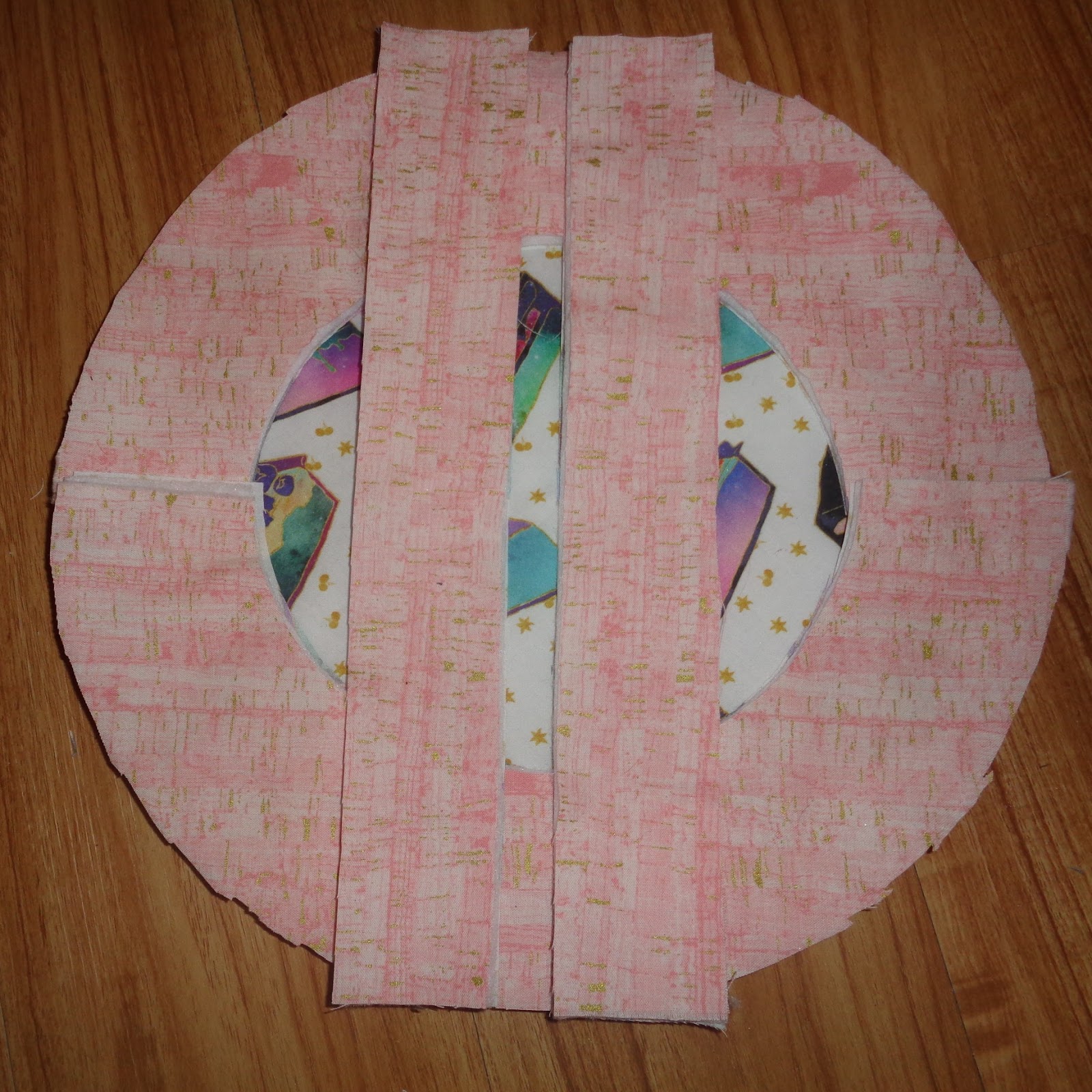
Next, cut the crescents that go on the top of the pie. I find the easiest way to do this is to cut another set of circles then use a smaller plate (salad plate, in this instance) as my guide to make the crescents about three inches thick, and cut it in half to make the two crescents. Again, you'll need one inside fabric, one outside fabric, and one batting.
Or cut the semi-circle first, then use the plate as your guide to make the crescents.
Use the little semi-circle as part of a heart-shaped oven mitt.
Cut the two straps. They should be about an inch longer than the diameter of your original circle and two to three inches wide. Now you have all the pieces: the circle, two crescents, and two straps; each one a set of one outside fabric and one inside fabric, both right sides out, with batting between them.
These crescents overlap a bit, so I need to trim them.
There we go.


Layers
Now you will sew the long edges of the straps and the inside edges of the crescents. Use a narrow seam allowance, and trim the edges as necessary.
Could have gone a little narrower, but that's nothing my Ginghers won't take care of.
Next, sew on the bias binding. I am lazy and bought bias tape; double-fold is best for all these layers. When you add it to the crescents, do the short, straight edge first. Sew your ties in when you add the bias binding to the inner curved edge. 
Make sure it's long enough to be tied into a bow; five or so inches will do it.

Sewn securely to the crescent.

Inner edges done!
Now layer the pieces, pin them in place, and sew the outer edges of the circle. As before, use a narrow seam allowance and trim the edges.
Watch out for the ties, and be sure to catch all the layers.
All you have to do now is sew the bias binding on the outer edge of the circle. And bake a dessert to go inside it.

Wednesday, May 15, 2019

If You Can Bead, You Can Make...


Working with beads is a great way to make beautiful things. They can be sparkly accents on handmade or storebought objects, or the beads themselves can be made into a gift. Craft stores carry a wide selection of beads, and of course there are stores specifically for beads as well. My favorite online source is ArtBeads.


Beads give this knitted necklace an elegant twist
(project and photo by Ravelry user Speattle, pattern here)
This purse is fully lined, giving it more durability and ensuring nothing will slip out the holes between the knitted stitches or the spaces between the beads.
(project and photo by Ravelry user Speattle, pattern here)

Jewelry, ornaments, and decorations are the easiest gifts to make with your beading skills. You have to think carefully before making a toy or heavily-used item out of beads; the beads might break, fall off, or get in the way of a "more practical" item's use. But a gift doesn't have to have a use beyond being beautiful for it to be appreciated.

My dad taught me how to make these bells. This YouTube tutorial is similar, although we use twelve 8mm faceted beads for the beginning circle and she uses the 3x6mm oat beads (the third type of bead is 4mm pearl beads; I've found all at JoAnn and other craft stores, and online on Etsy and eBay). A written pattern very close to how we do it is here.


Left and right are jewelry pieces my sister-in-law made for me to wear in my wedding (left; I commissioned her) and hers (right; I was a bridesmaid). Middle is a set my best friend made me for Christmas.
Not strictly beading, but similar--a coworker of my husband's makes dreamcatchers uses feathers she finds at their workplace, owl, crow, and northern flicker in this instance. This is hanging in our kitchen.
A selection of Christmas ornaments I've been given by various friends with beaded accents


You don't need to be a beading master to enjoy it. Kids can get in on the fun, too.
My cousin made this for me when were teens. My kids play with it now.


There's a certain charm to these creations of my two- and four-year-olds.


Beads as accents or the entirety of baskets, keychains, clothing, curtains, accessories, jewelry, wall hangings, frames--they can add a touch of beauty, elegance, fun, or whatever you want. With so many kinds of beads and charms, your imagination is the limit.

Monday, April 15, 2019

Sewing Tutorial: Art, Craft, or Makeup Supply Pouch

My four-year-old’s preschool teacher asked me to come talk to the class about sewing. I told them (briefly) about finding patterns, picking fabric, cutting pieces (with warnings about asking an adult first and to only use them cutting tools for fabric), sewing them together…and ripping seams. I’ve been wanting to use up my leftover pieces, so I made each kid a little marker/pencil/paintbrush/etc holder. I had a lot of markers that one of my mom's friends gave me, enough to put two in each of the eighteen holders. 


SUPPLIES

Less than a fat quarter’s worth of fabric scraps
Batting
Ribbon

DIRECTIONS

Once the fabric is prewashed and ironed, cut four 7x9inche pieces. Cut a 7x9 inch piece of batting, and two 20 inch long pieces of ribbon. Decide which pieces of fabric are for which part. You’ll need an outer fabric, an inner fabric, a flap, and a pocket. The inner fabric will show the least.

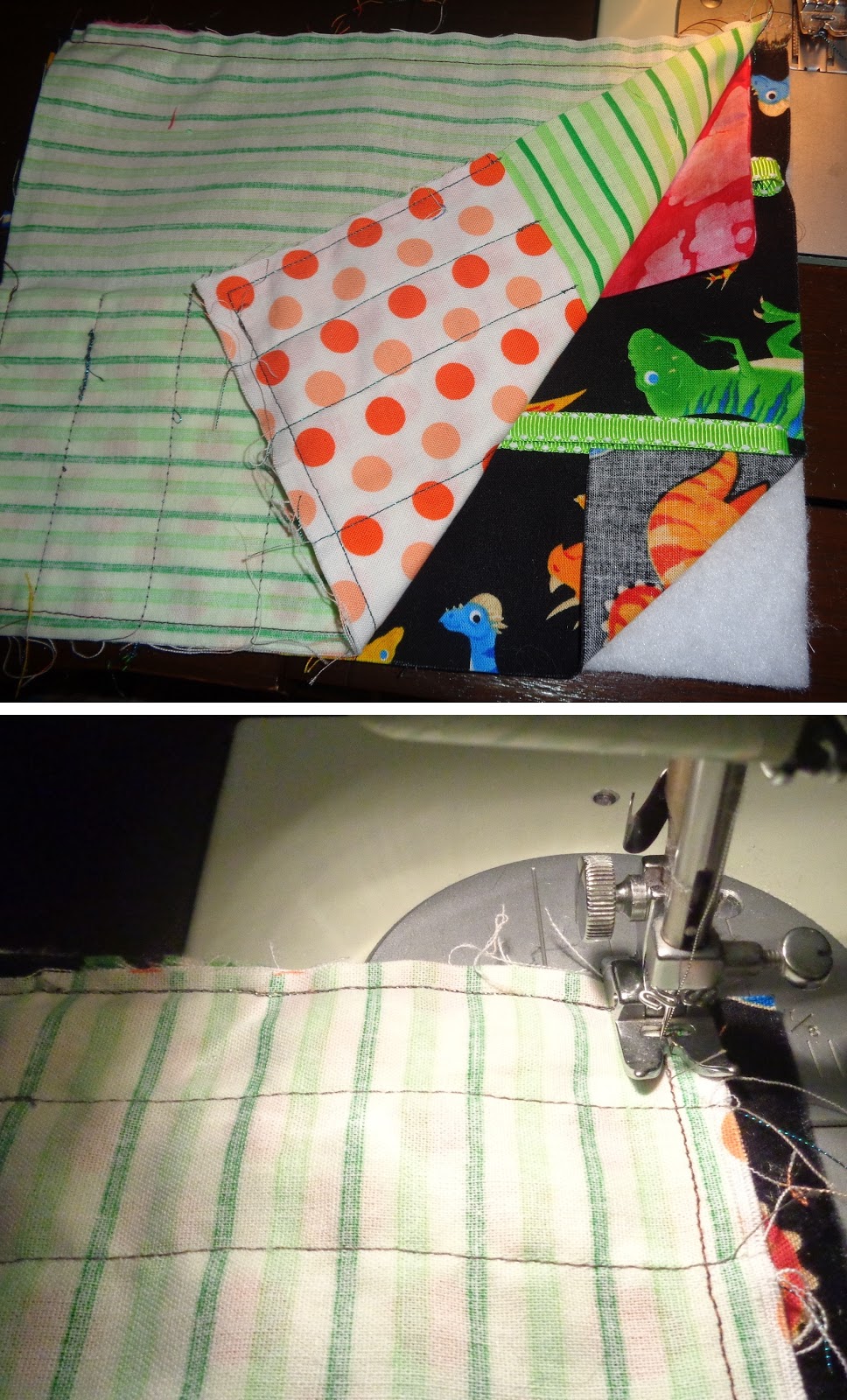
Here, my outer fabric is dinosaurs,, my inner fabric is green stripes, my flap is red, and my pocket is orange polka dots
Fold the flap fabric right sides together lengthwise (making a 4.5x9 inch piece). Sew the short (4.5 inch) edges closed, using a large seam allowance—I used half an inch. Turn right side out and press to make a crease along the folded edge. Fold the pocket piece wrong sides together in half lengthwise and iron to crease the folded edge.


Layer the pieces as follows: inner fabric right side up, flap on top, pocket on bottom. Sew the fllap in place along the top and all along the raw (non-folded) edges of the pocket, using a narrow seam—about a quarter inch.

Mark the middle of the pocket lengthwise, and mark about every inch and a quarter from the middle to both edges. Using your ruler and disappearing ink, draw lines to guide the sewing of the eight pocket compartments. Sew along guide lines.


Sew the ribbon on the outer fabric, about two inches from the top and two inches from the bottom. Only sew about four inches of the ribbon, starting half an inch from on edge.

Sandwich the pieces together as follows: batting, outer fabric right side up (be careful to tuck the ribbon in), inner fabric (with flap and pocket pieces sewn on) right side down. Sewn all along the perimeter, using the stitches you’ve already sewn as a guide. Leave an opening for turning.

Turn, iron, and top-stitch. This step and the step for putting on the ribbon are good for decorative stitches. Since I was making 18 of these, I just used a simple zig-zag.