Showing posts with label school. Show all posts

Saturday, May 1, 2021

Gifts for Athletes, Coaches, and Sports Enthusiasts

A person's hobby or passion is a great starting point for brainstorming gifts. For people into sports, whether they compete themselves or just like to watch, there are a lot of ideas.

SPORTING SUPPLIES

Athletes often go through a lot of supplies: athletic tape, pre-wrap, Band-Aids, and ice packs are a good bet for most. Healthy snacks and water are also a good idea, especially for long competition days. For outdoor sports, sunscreen or other sun protection is a must--people can get sunburned even on overcast days, and it's not uncommon for people to forget how well snow reflections UV rays and end up badly sunburned while participating in snow sports. Depending on how close to nature the outdoor sports get, bug repellant or antihistamine lotion could be good, too. While coaching cross country, I have twice been to meets where the race course ended up going by a hornet nest. Fortunately, the athletes who got stung weren't allergic (the one who was allergic had forgotten his sting kit the first time, but never did again!).

Most athletes have at least a few pieces of equipment they have to transport from one place to another. Whether it's a full set of pads for football or just specialized shoes for racing, it's nice to have a good, sturdy bag (handmade or store-bought) or other way to carry the things around. Some equipment is tougher to carry than others--poles for pole vault aren't heavy but are very long! If you find a creative solution, offer it. My track and field coach saw a large plastic pipe at a construction site while he was on the way home from work, pulled over, and asked how he could buy one. It was wide enough in diameter to fit several poles in, so while it was still a two-person job to carry the poles, they were no longer slipping around as we did. Heavy equipment like weights and throwing implements need very sturdy carrying cases; others might need very large ones. Most athletes have at least two layers for competitions, warming up perhaps in sweats and then competing in a shorts-and-t-shirt sort of uniform. If you're able, you can offer to watch the athlete's things during the competition. When I coached, I bought the team a backpack with lots of pockets to keep jewelry in, as it wasn't allowed to be worn during competition (I also bought pads and tampons to keep in it, given out at the discretion of the girls' team captain).

There is a plethora of sport-specific equipment. A track and field athlete might need replacement spikes to screw into her jumping cleats, a soccer player might need new shin guards, a volleyball team might need a new net. Corporate sponsors often help teams by purchasing uniforms or other supplies in exchange for having the company name advertised at games--plus it helps the often-young athletes learn valuable social, health, and time-management skills.

SPORTING SUPPORT

Athletes and coaches put a lot into their passion. Acknowledging their hard work is a great gift. By simply showing up to a sports event to watch your nephew pitch or your sister come in under par or your friend coach a basketball team, you're demonstrating that you appreciate that time and effort. 

My grandparents had a tradition: when one of their grandchildren earned a varsity letter, they'd buy that grandchild a letterman's jacket. I loved getting mine after working to earn it! 

Supporters might also bring healthy snacks like fruit, or water. Maybe a team has a tournament far away and needs to raise cash to fund the trip--spreading the word about the team car wash or other fundraiser is helpful, as is donating gasoline gift cards or other in-kind help. When I did high school sports, a teammate's parents took pictures throughout the season and gave each of us an envelope with a couple dozen pictures of our season highlights. I still have some of those pictures years later!

FAN GEAR

Someone who supports a team, whether playing the sport or not, is likely to appreciate items with the team's logo on it. You do need to be sure not to go overboard; most people don't like getting the same thing year after year or being defined solely by one aspect of a personality. But if you know someone would like a team shirt (and the person's clothing size!), or beer mug, or home décor object, or team-emblazoned household objects like cooking utensils, you're set. My husband loves the Green Bay Packers cheesehead my brother gave him for Christmas years ago. Maybe a book or movie about the team's history or triumphs exists, or team-themed food. They don't even have to be team-specific: Girl Scouts are told to suggest people buy boxes of cookies in colors that support local teams, like green Thin Mints and blue Trefoils for the Seahawks, Mariners, and Sounders here in the Seattle area.

If the team is local or will be playing nearby, a pair of tickets could be perfect. As with any time-sensitive gift, be sure your recipient's schedule and health allow for the outing. Some teams hold events (in their local areas) for meeting fans; that's another fun option.

A great piece of memorabilia is autographs. They can be pricey on websites like eBay, but that's not the only place to get them. Teams that hold events open to the public like picture days are a good place to find autographs. I've been able to get a few just by writing to the team or athlete and asking (include a self-addressed stamped envelope). My mom got me an autograph of an Olympic athlete the same way, by writing to the college where she now coaches. Keep your eyes open at sporting events: my brother and I have both been at track meets attended by Olympians who were happy to give us autographs when we asked. Another time, I was at the homecoming game for a college football team, and overheard two other people in the stands talking. I told them it sounded like they were reminiscing about having played and it turns out they were two of the more famous past players. They were flattered to be asked for an autograph, and gladly signed my ticket. Any sports fan will love having a piece of history!
Left to right: Stacy Dragila, Dave Johnson, Cliff McBride,
Spider Gaines, and Tommie Smith


Monday, February 1, 2021

Sewing Tutorial: Fidget Mats

I love the marble mazes I posted two months ago, but they might not be appropriate fidget toys if you need to worry about choking hazards--enough chewing can get the marbles out, and babies and some older people are going to chew. Here's an alternative sewing project for when that's a concern. It's also a great way to use up small amounts of fabric and ribbon.

No choking hazards here!

SUPPLIES

Four pieces of different textures of fabric
Six (or more) ribbons of different texture and width--none with wires
Fabric scissors
Regular scissors
Rotary cutter
Cutting mat with grid and ruler
Clean potato chip bag

Regular scissors lest your sewing ancestors haunt you
when it comes time to cut the bag.
DIRECTIONS

Cut the ribbon into four-inch (10 cm) long pieces. If you only have a small amount of ribbon, three inches  (7.5 cm)will suffice, but four is easier to work with.
If possible, have each ribbon a different texture than the other.
Using your regular scissors, cut the potato chip into a ten inch by ten inch (25 cm) square. The bag should already have been wiped clean and run through the dishwasher or washing machine. You can also use any sort of bag with the same feel as a potato chip or buy crinkle paper outright.
USE REGULAR SCISSORS, NOT FABRIC SCISSORS
Next, cut three of your fabrics into three-inch (7.5cm) wide by nine-inch (23 cm) wide strips, and the fourth into a nine-inch by nine-inch (23 cm) square. 
I used fleece, a silky piece, and minke for the strips,
and flannel for the square.

Now you should have six lengths of ribbon, one chip bag square, three strips of fabric, and one square of fabric. Time to start assembling the fidget mat.
Ready to go
Sew the strips along the long edges with the right sides facing, to make them into a square.
I chose to order them fleece, silky, minke
Square up the edges.
See-through rulers with grids are the best.
Fold the ribbons in half and pin then around the perimeter, leaving a little bit of each raw each hanging over the side, to ensure they get caught when you sew them in place.
You can sew them in right now and remove the pins,
or after the next step and just take extra care to watch for pins when turning.
Layer your pieces with the chip bag on the bottom, fabric square right side up, strips with ribbons right side down. 
The bag might try to curl, which is why having it bigger than
the fabric pieces is nice.
Pin or clip the pieces together and sew around the perimeter, leaving a space open for turning.
If you haven't already sewn in the ribbons, watch for those pins.
Trim the extra edges of the chip bag.
USE REGULAR SCISSORS. DO NOT USE FABRIC SCISSORS.
Trim any bulky pieces of ribbon and fabric as needed.
Back to fabric scissors.
Use a zig zag to top stitch the perimeter...
The ribbons are very secure now!
...and the seams between the strips, and you're done!
This also helps the chip bag piece stay in place.
Now the fidget mat is ready to be played with. The bag inside the fabric makes a fun crinkly noise when bent or squeezed, and the ribbons and fabric provide a variety of textures to rub.

Sunday, December 15, 2019

Gifts for Graduates

When a young adult is embarking on the next stage of life, the easiest gift is cash. And it's certainly appreciated! Bonus points if the graduate's next step is in another country and you can get some foreign bills at a bank--check ahead of time, it might take a week or more for those bills to be available. If you feel the need to give a more personalized touch, here are some ideas:

GIFT CARDS

Not very different from cash, gift cards can feel more personal because they can be tailored to specific interests and needs. Is the new graduate moving to another city for college, trade school, or work? Gift cards for restaurants, grocery stores, and home furnishing and appliance stores in their new cities can help set up a new apartment. If you're looking for a more fun gift card, consider movie theaters, live theaters, gaming centers, museums, zoos, and other entertainment in the area. Out-of-town stores can often send gift cards through the mail via their websites or over the phone (you might need to offer another dollar or so to cover a stamp and an envelope for small stores). Graduates staying close to home will also appreciate a grown-up or fun reward to celebrate their hard work

If the new graduate is studying or working in a specific field that will require certain supplies, you can give a gift card to a store that sells them: art supply store for the art student, dry cleaning or tailoring vouchers for uniformed service members like police officers or military members, certificates for tools for someone apprenticed to a carpenter, contributions to the university bookstore for people majoring in fields that have lots of expensive books like law and medicine. Giving a gift card rather than the specific item allows the graduate to not worry about duplicate gifts and getting the exact item needed.

MEMENTOS

Especially if they're leaving behind a lot of good memories and friends, many graduates will appreciate a memento of home. If the graduate is moving, be mindful of how much might need to be packed and transported, and how far, before giving a large gift.

Mementos don't have to be huge. A photo collage or scrap book, maybe even signed by the people in the pictures, is a nice way to remember friends embarking on their own paths. A card signed by everyone can also be touching--when my brother graduated high school and moved a few states away for college, I was able to get a lot of his friends to sign a birthday card to send him. He really loved reading all their thoughtful comments a few months into his first significant time away from where he'd always lived.

You can make other mementos, like sewn, knitted, or crocheted blankets or throw pillows in the graduate's high school or college colors, or with designs relating to the graduate's field of study or work (for example, anchors for someone joining the navy). Maybe a pair of earrings or cufflinks with the same themes would be appreciated, or a wall hanging or other decor. Depending on your talents and time, you can make these sorts of things yourself or look to online craft shops like Etsy.

CELEBRATING THE ACCOMPLISHMENT

Regardless of what the graduate's plans for the future are, finishing high school or college is a lot of work. (Some people mark smaller graduations, from preschool or middle school, for example, but in my experience the biggest gift "expected" for those is a treat on the way home from school that day. If you feel compelled to give something larger, you'll obviously want to gear that towards the child's age.)

The new graduate might be heading to work right away. Gifts that allow a person to indulge a bit have special meaning if there are financial pressures. Think about what the graduate enjoys and see if you can facilitate that. If the financial pressures are great, think about gifts that can help with essentials too. And even if the graduate is simply eager to join the workforce, a gift that helps someone feel "allowed" to relax is very nice.

Is the graduate planning a fun trip? Contributions for gasoline, road atlases (not everywhere has wifi signals), or brochures about where they're traveling can be useful. You can often contact a city or county's tourism office and get information mailed to you for free. Maybe a photo album to commemorate the trip, or offering to pay to have one made--Facebook has an option to print photo books from the pictures stored on a person's profile.

Is there a party to celebrate the graduate's achievement? Maybe you can help make some food for it, or help set up or clean up the party. Even just attending and saying congratulations can mean a lot. If you can't make it, write a letter and mail it. People appreciate knowing that they matter to others.

SETTING UP FOR ADULT LIFE

Gifts geared toward new adult responsibilities are especially helpful for those moving out on their own or who will be expected to contribute to the household more. Cash and gift cards are probably more useful for those not moving out of their childhood homes yet or those who will be moving right into dorms or military barracks where many essentials are provided, but are certainly also good for those living on their own or with roommates for the first time (and easy to mail). 

Someone setting up in a new home will definitely appreciate a "gift basket" of cleaning supplies, kitchen staples, yard tools (if they have a yard), or toiletries. Think about what you use every day (like pots, pans, utensils, mops, brooms, towels, etc) and what you don't often need to buy because it's already at your home in bulk (spices, toilet paper, etc). When I graduated high school, one of my aunts gave me a tool kit. I lent it many people in the dorm, and still have it today, more than a decade after I finished college.

A graduate entering the workforce would likely benefit from help setting up a proper work wardrobe, whether the need is specific uniforms or durable suits. Depending on the job, a sturdy portfolio, quality pen, briefcase, laptop case, messenger bag, or other similar item might be necessary. If the job requires travel, consider suitcases, travel drink cups, AAA membership, options for entertainment during travel like iTunes or Netflix gift cards, books, and other such items.

If none of these ideas jump out at you, think about what you might have received or wanted as a gift when you entered the adult world. What was helpful or meaningful for you?

Friday, November 15, 2019

Gifts for: Teachers and Other School Employees

Whether you're a student or the parent of one, you will probably find it appropriate to give teachers and school employees gifts once in a while. Right off the bat, the first thing you should do is check your school's policy: some may not allow gifts above a certain monetary amount, or ban homemade food, or not allow gifts at all. 

With that in mind...

HOMEMADE

A caution here: the teacher or other school employee likely has many students. If every student gives the bus driver a knitted scarf, it's going to be difficult for the driver to use the few dozen scarves. Before you craft something, consider whether your recipient will be able to appreciate your effort. Smaller, consumable gifts are safest. If policy allows, food, especially food that can be frozen and enjoyed when the recipient feels it's best, is a great choice. Cookies, bread, homegrown vegetables or flowers; just consider allergies.

That said, I have made non-consumable gifts that were well-received. My oldest child's kindergarten teacher had a classroom mascot, a bee called Super Bee. When it was our turn to have it for an evening, I took some measurements and sewed a superhero cape, which we gave the teacher for Christmas. Later in the year, the teacher had to have surgery and take some time off, and another parent crocheted her a blanket to help keep her comfortable during the recovery (we gave her a gift card to a pizza place that time). I'm not trying to say that you're not allowed to make a present, just that you should be aware that other students are likely to give presents as well. You don't want to overwhelm your recipient.


Common homemade gifts include Christmas ornaments (do check that your recipient celebrates Christmas), accessories like hats and gloves, picture frames, household goods like pillows, hot pads, and throws, and, more often in the case of young students, drawings and notes. Smaller objects that might wear out faster, like dishcloths, are a better bet than big ones unless you know the recipient well. On the other hand, if you're giving a gift to someone who interacts with fewer students like a paraeducator or someone less likely to receive gifts like the school librarian, you don't need to be as concerned.

I mentioned notes in the previous paragraph. I have family members who are teachers, and one thing they cherish is notes from students about the positive impacts they've made. And having been a coach and gotten a few of those myself, they are priceless. I still have them almost a decade later, with the framed pictures of the teams--the athletes signed the frames, too.

STOREBOUGHT

Again, be sure you don't overwhelm your recipient. One can only use so many "BEST TEACHER" coffee mugs. A first year teacher, maybe. A twenty-year veteran? Probably less likely.

Teachers I know love gifts they can use in their classrooms. When we moved to a different state in the middle of a school year, I made sure to grab pens and pads of stationery from the souvenir section of a drug store. We gave them to the teacher in the new state just before the holiday break. She used them for sending notes home to parents. We gave one speech therapist stickers, which were used to mark students' progress, and another a ten dollar gift card to Michaels, because she used craft supplies so often.

Speaking of gift cards--they are wonderful for school employees. It's unlikely you know the bus driver well enough to pick up on his favorite colors or the principal well enough to find out her shoe size for knitted socks. But everyone needs to eat, and most employees who do classroom work with students can use funds for stores that sell art and school supplies.

Include a note, even a short one. Most people working in education are doing so because they want to help students, and knowing they've made a positive impact is a great gift. 

Monday, April 15, 2019

Sewing Tutorial: Art, Craft, or Makeup Supply Pouch

My four-year-old’s preschool teacher asked me to come talk to the class about sewing. I told them (briefly) about finding patterns, picking fabric, cutting pieces (with warnings about asking an adult first and to only use them cutting tools for fabric), sewing them together…and ripping seams. I’ve been wanting to use up my leftover pieces, so I made each kid a little marker/pencil/paintbrush/etc holder. I had a lot of markers that one of my mom's friends gave me, enough to put two in each of the eighteen holders. 


SUPPLIES

Less than a fat quarter’s worth of fabric scraps
Batting
Ribbon

DIRECTIONS

Once the fabric is prewashed and ironed, cut four 7x9inche pieces. Cut a 7x9 inch piece of batting, and two 20 inch long pieces of ribbon. Decide which pieces of fabric are for which part. You’ll need an outer fabric, an inner fabric, a flap, and a pocket. The inner fabric will show the least.

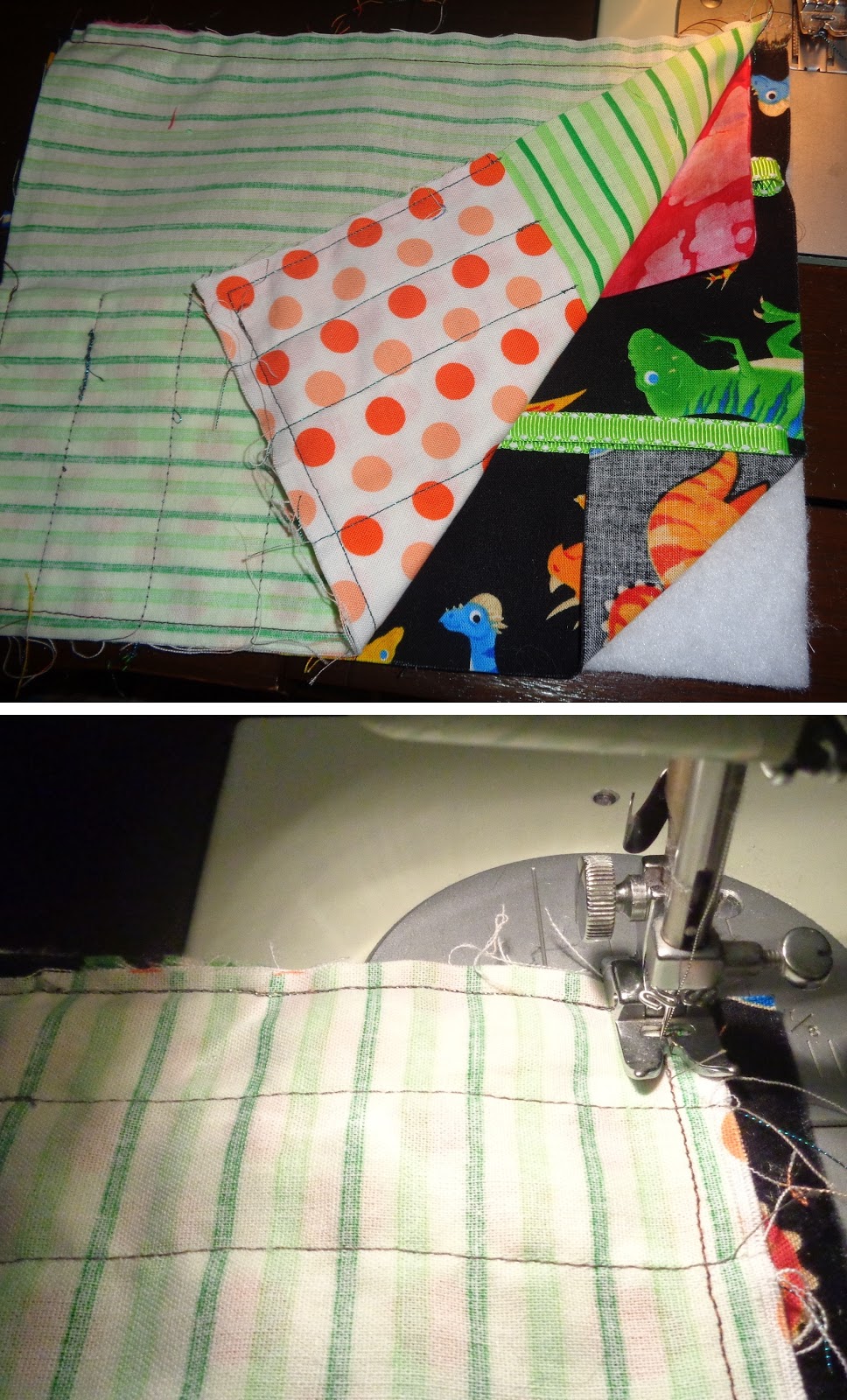
Here, my outer fabric is dinosaurs,, my inner fabric is green stripes, my flap is red, and my pocket is orange polka dots
Fold the flap fabric right sides together lengthwise (making a 4.5x9 inch piece). Sew the short (4.5 inch) edges closed, using a large seam allowance—I used half an inch. Turn right side out and press to make a crease along the folded edge. Fold the pocket piece wrong sides together in half lengthwise and iron to crease the folded edge.


Layer the pieces as follows: inner fabric right side up, flap on top, pocket on bottom. Sew the fllap in place along the top and all along the raw (non-folded) edges of the pocket, using a narrow seam—about a quarter inch.

Mark the middle of the pocket lengthwise, and mark about every inch and a quarter from the middle to both edges. Using your ruler and disappearing ink, draw lines to guide the sewing of the eight pocket compartments. Sew along guide lines.


Sew the ribbon on the outer fabric, about two inches from the top and two inches from the bottom. Only sew about four inches of the ribbon, starting half an inch from on edge.

Sandwich the pieces together as follows: batting, outer fabric right side up (be careful to tuck the ribbon in), inner fabric (with flap and pocket pieces sewn on) right side down. Sewn all along the perimeter, using the stitches you’ve already sewn as a guide. Leave an opening for turning.

Turn, iron, and top-stitch. This step and the step for putting on the ribbon are good for decorative stitches. Since I was making 18 of these, I just used a simple zig-zag.