Wednesday, May 15, 2019

If You Can Bead, You Can Make...


Working with beads is a great way to make beautiful things. They can be sparkly accents on handmade or storebought objects, or the beads themselves can be made into a gift. Craft stores carry a wide selection of beads, and of course there are stores specifically for beads as well. My favorite online source is ArtBeads.


Beads give this knitted necklace an elegant twist
(project and photo by Ravelry user Speattle, pattern here)
This purse is fully lined, giving it more durability and ensuring nothing will slip out the holes between the knitted stitches or the spaces between the beads.
(project and photo by Ravelry user Speattle, pattern here)

Jewelry, ornaments, and decorations are the easiest gifts to make with your beading skills. You have to think carefully before making a toy or heavily-used item out of beads; the beads might break, fall off, or get in the way of a "more practical" item's use. But a gift doesn't have to have a use beyond being beautiful for it to be appreciated.

My dad taught me how to make these bells. This YouTube tutorial is similar, although we use twelve 8mm faceted beads for the beginning circle and she uses the 3x6mm oat beads (the third type of bead is 4mm pearl beads; I've found all at JoAnn and other craft stores, and online on Etsy and eBay). A written pattern very close to how we do it is here.


Left and right are jewelry pieces my sister-in-law made for me to wear in my wedding (left; I commissioned her) and hers (right; I was a bridesmaid). Middle is a set my best friend made me for Christmas.
Not strictly beading, but similar--a coworker of my husband's makes dreamcatchers uses feathers she finds at their workplace, owl, crow, and northern flicker in this instance. This is hanging in our kitchen.
A selection of Christmas ornaments I've been given by various friends with beaded accents


You don't need to be a beading master to enjoy it. Kids can get in on the fun, too.
My cousin made this for me when were teens. My kids play with it now.


There's a certain charm to these creations of my two- and four-year-olds.


Beads as accents or the entirety of baskets, keychains, clothing, curtains, accessories, jewelry, wall hangings, frames--they can add a touch of beauty, elegance, fun, or whatever you want. With so many kinds of beads and charms, your imagination is the limit.

Wednesday, May 1, 2019

Gifts for Saying Thanks

Most of the time, a thank you note is enough acknowledgement for a gift (depending on your relationship with the gift giver and the occasion, thanking in person or by phone call, text, or email can also work). Some gifts are so appreciated that you might feel compelled to go a step beyond.

THANKS FOR THE GIFT; HERE'S ONE FOR YOU

For example, someone once gave us a car. It was a time we really needed one, and the previous owner wouldn't even let us pay for the check-to-buy inspection he insisted be done. We were obviously incredibly grateful. To show our gratitude, we sent pictures of our kids and the car "going on trips" (i.e.; being used as the previous owner had hoped) and I knit a blanket in the previous owner's favorite colors, sent with a letter about how much of a blessing the car was. Before we were given that car, I also knit a blanket for a couple who loaned us their car when they were on a three-week vacation. Their vacation matched up nicely with some appointments that would have been difficult to manage on the bus.

Handmade additions to thank you notes are often a good way to go. A batch of cookies, some homemade bread, useful household items like potholders; they're little ways to show you appreciate the extra effort someone took to do something really special. I especially like handmade things if I'm given craft supplies. A few times, I've been the recipient of someone clearing out sewing or knitting stashes. Making someone a small thank you gift from the supplies is my way of showing that I can put the supplies to immediate use. Even a picture of something I've made with the supplies can brighten the giver's day.

Generally, I would give something back to whoever gave me the supplies, but sometimes showing how I'm paying the gift forward is even better. For example, when my grandmother-in-law gave me her yarn supplies, I integrated some of her crochet swatches into Christmas presents for my nieces and nephew, her great-grandchildren. She really appreciates knowing that they have keepsakes of her.

If you're not up to making something or you don't think the person would appreciate it, gift cards are always great, especially for restaurants. It's a way of saying that since the person made your life easier, you're returning the favor.

THANKS WHEN TRAVELING

Hostess gifts are fairly common whether you're going to a friend's house for dinner or staying at someone's house for a few nights.You might want to bring along a dessert or appetizers to go with the meal. Whenever I spend the night at my parents' house, I bring dinner--usually lasagna. Bottles of wine are a classic go-to. If you're not sure whether alcohol is appropriate, you might want to pick out some food item your area is known for or locally made soap or candles (especially if the thank you gift is to thank a hostess when you're visiting from out of town). When we took a road trip around the country, we brought things like smoked salmon from Seattle to friends and relatives in other states who we stayed with. 

If you're gone for a while, you might have someone watering your plants, collecting your mail, or taking care of your pets. On a different road trip, we brought back coffee from Yellowstone National Park to thank the friend who took care of our cat while we were away. 

Gift cards are also great; enclosing one with a thank you note doesn't even require an extra stamp on the envelope.

THANKS FOR WEDDINGS

For wedding attendants, common gifts include jewelry (especially if it's to be worn at the wedding), alcohol, or paying for some or all of the attendants' attire or travel, and there are other ideas too. My dad was best man at a few weddings, and one couple passed out books about home maintenance. About four decades later, Dad still references that book. 

You might want to give something to the wedding officiant too, or other people involved in setting up the wedding (of course, the professionals are also getting paid, so they are getting some compensation). I opted to make a blanket for the priest who married us and sent it on our first anniversary, but in my case, it was the same priest who had also baptized me, given me first communion, and had been at my confirmation. He's a family friend.

Many weddings also have some sort of memento for guests to take home. My two personal favorites I've seen are coasters that fit theme of the wedding (check Oriental Trading Company for good bulk rates) and candy stations, where guests can fill bags of sweets which are usually color-coordinated with the wedding colors. The last wedding I attended had this, and the snacks were nice for the plane trip home.

THANKS FOR YOUR TIME AND TALENT

When an era is coming to a close, be it a retirement, the school year ending, the big theater production having its last performance, or whatever else it is, it's natural to want to show the people who made it all worthwhile that you appreciated it. A card or collection of cards from everyone, a picture everyone signed, a gift card everyone chipped in for--it doesn't have to be extravagant. Having been a coach, I can say that knowing I helped my athletes learn something new or enjoy a season means a lot. 

Many people like to recognize service workers at the holidays: letter carriers, regular hair stylists, sanitation workers; anyone whose services you rely on to make your life easier. I like to get small gift cards or little treats. During a hot stretch last summer, I put some cold drinks in a cooler for the waste management people, and when it dropped below freezing for several days, I left hand warmers out.


Again, in most cases the thank you is thanks enough. There are times though that you receive something truly moving, or you want to find a way to show how important someone is to you, and a little something extra feels right.

Monday, April 15, 2019

Sewing Tutorial: Art, Craft, or Makeup Supply Pouch

My four-year-old’s preschool teacher asked me to come talk to the class about sewing. I told them (briefly) about finding patterns, picking fabric, cutting pieces (with warnings about asking an adult first and to only use them cutting tools for fabric), sewing them together…and ripping seams. I’ve been wanting to use up my leftover pieces, so I made each kid a little marker/pencil/paintbrush/etc holder. I had a lot of markers that one of my mom's friends gave me, enough to put two in each of the eighteen holders. 


SUPPLIES

Less than a fat quarter’s worth of fabric scraps
Batting
Ribbon

DIRECTIONS

Once the fabric is prewashed and ironed, cut four 7x9inche pieces. Cut a 7x9 inch piece of batting, and two 20 inch long pieces of ribbon. Decide which pieces of fabric are for which part. You’ll need an outer fabric, an inner fabric, a flap, and a pocket. The inner fabric will show the least.

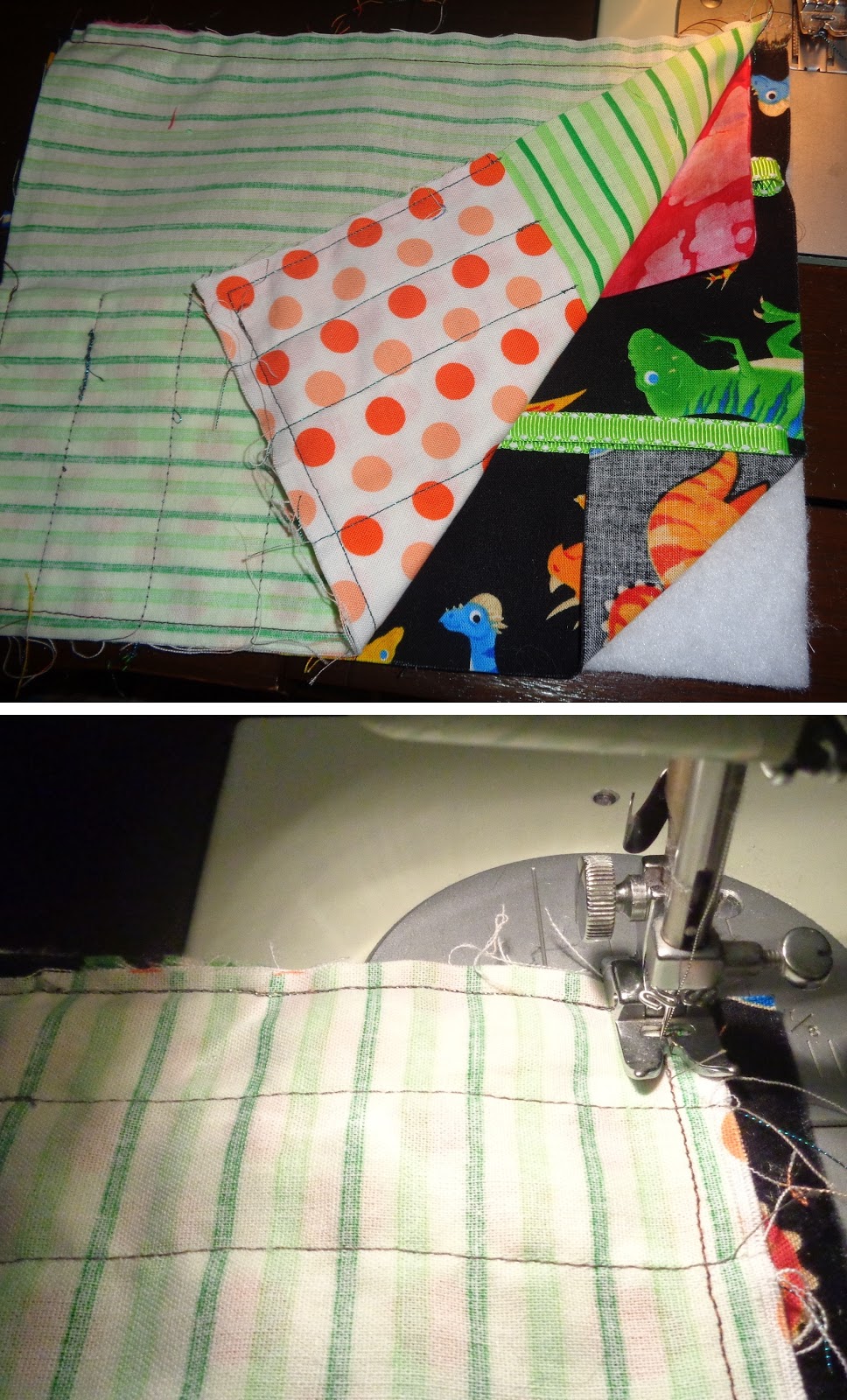
Here, my outer fabric is dinosaurs,, my inner fabric is green stripes, my flap is red, and my pocket is orange polka dots
Fold the flap fabric right sides together lengthwise (making a 4.5x9 inch piece). Sew the short (4.5 inch) edges closed, using a large seam allowance—I used half an inch. Turn right side out and press to make a crease along the folded edge. Fold the pocket piece wrong sides together in half lengthwise and iron to crease the folded edge.


Layer the pieces as follows: inner fabric right side up, flap on top, pocket on bottom. Sew the fllap in place along the top and all along the raw (non-folded) edges of the pocket, using a narrow seam—about a quarter inch.

Mark the middle of the pocket lengthwise, and mark about every inch and a quarter from the middle to both edges. Using your ruler and disappearing ink, draw lines to guide the sewing of the eight pocket compartments. Sew along guide lines.


Sew the ribbon on the outer fabric, about two inches from the top and two inches from the bottom. Only sew about four inches of the ribbon, starting half an inch from on edge.

Sandwich the pieces together as follows: batting, outer fabric right side up (be careful to tuck the ribbon in), inner fabric (with flap and pocket pieces sewn on) right side down. Sewn all along the perimeter, using the stitches you’ve already sewn as a guide. Leave an opening for turning.

Turn, iron, and top-stitch. This step and the step for putting on the ribbon are good for decorative stitches. Since I was making 18 of these, I just used a simple zig-zag.

Monday, April 1, 2019

Sewing Tutorial: Charming Soft Baby Cube Toy

I first made one of these as a baptism present for my cousin’s baby girl. The six symbols are an Ichthus (Jesus fish), Alpha and Omega, INRI (Iesus Nazarenus Rex Iudoreum, Latin for Jesus of Nazareth, King of the Jews), an IHS symbol (Latin for In Hic Signa, which means in this sign, from the story of Constantine’s conversion to Christianity), a Chi-Ro (one way to abbreviate Christ, again from Latin), and a cross. I later also made a set of simpler ones with geometric shapes: circle, square, triangle, octagon, star, and heart. Both sets of shapes are in the PDF at the bottom of the page, which you can download to act as a guide for cutting the shapes.
She's one of my godchildren
SUPPLIES

Six charm squares or one quarter yard of background fabric
Six charm squares or one quarter yard of fabric for the shapes/symbols
Poly-fil or other stuffing
Optional: 6-12 jingle bells

DIRECTIONS

Prewash and iron your quarter yard of background fabric. Cut six 5x5 inch squares, one for each of the cube’s faces, or iron your six background charm squares. If you’re using a single cut of fabric and want all the faces the same size, you can also cut a cross shape told fold into a cube.
 I still sewed along the edges of this one to help it keep its shape.
Prewash and iron your second fabric, or iron your second six charm squares. Cut your desired shapes and appliqué them onto the six faces of the cube. 
Assembly line!
Using a quarter-inch seam allowance, sew the faces to each other right sides together along their edges. Leave an inch or two open for turning and stuffing. Be sure they’re facing the ways you want them to, and that they’re in the order you want. The arrangement is completely up to you, just be sure you do it the way you mean to. 
 For the religious symbols, I like the Ichthus and the Alpha and Omega on opposite sides, the INRI and IHS on opposite sides, and the Chi-Ro and cross on opposite sides. For the shapes, I pair them circle and octagon, square and triangle, and heart and star. 
Once they’re sewn and turned, stuff them firmly with Poly-fil or something similar. If desired, put a jingle bell or two in the middle so the cube will make a noise when shaken. Hand stitch up the last little bit, and you’re done!
A bit of thread to close that gap, and they’re ready to be played with. 
Here is the PDF of the symbols and shapes: Shapes and Symbols

Friday, March 15, 2019

If You Can Knit or Crochet, You Can Make...


Knowledge of needle arts is useful for gift-giving. There are a variety of things, large or small, easy or difficult, that make great gifts. Of course, keep your recipient in mind: not everyone appreciates handmade items, and even if they do, they might not like the specific item you've chosen--no matter how beautiful, an intricate Christmas ornament isn't appropriate for someone who doesn't celebrate Christmas. So long as you know your recipient doesn't have a strong preference for store-bought items and you have the right category of gift in mind, and that you have enough time to complete the project, you're set. Patterns are all over the place online and at bookstores, yarn stores, and libraries. For example...

BLANKETS


There are patterns for all sizes of blankets, and lots of fun designs as well. Baby blankets, toddler-sized lap robes, afghans all the way to king size, teeny sizes for pets or dolls--it just depends how much yarn and time you want to use! 


How do you pick a pattern? The search engine on Ravelry (a wonderful website) is a fantastic resource--you can input yarn weight, needle sizes, yarn amount, and select whether you want your results to show free or paid patterns and patterns for knitting or crochet. Think of the size you want, and how complicated you want the pattern to be, and go from there. Some patterns make pictures--this one makes a Diplodocus:


Picture by Ravelry user amgoth2000, Diplodocus Blanket, pattern here
This one makes a roadway for toy cars:
Picture by Ravelry user HappyBerry, pattern Road Play Mat, found here
Once you have your pattern selected and you have appropriate yarn (that is, the correct weight, yardage, and appropriate fiber content--machine-washable is best for babies), it's time to figure out colors. Maybe a favorite sports team--and there are also patterns for many of the logos--wedding colors, colors from a pop culture item (maybe a big blanket striped in the colors of the famous scarf from Doctor Who), the recipient's favorite colors... Keep in mind that complicated patterns, such as ones with lots of cables, work best with few or one color. Too many colors can make the pattern hard to see. My personal preference is to knit (because I'm terrible at crochet) fairly simple patterns with two strands of yarn at once. I use patterns meant for bulky weight yarn, and hold two colors of worsted weight as if they were one, which gives me a nice blend of colors.
Picture by Ravelry user SiffKnit, pattern Susan's Zig Zag or Chevron Blanket, pattern here
Picture by Ravelry user SiffKnit, pattern Susan's Random Remnants Blanket, pattern here


CLOTHING AND ACCESSORIES

Hats, cowls, scarves, mittens, socks, shawls, even jewelry--there are patterns for everything. One thing I love to do is put my recipient's name into the Ravelry search engine, and find an accessory with the name. Joel's ScarfPaul's HatJane Necklace, and so on. And you can just as easily find patterns for clothing like this: Oriental Lily DressScott SweaterKatie Blouse, and so many more. There are also patterns geared toward times of the year that can be fitting, like the May Baby Sweater for a baby born in May.
Picture by Ravelry user Speattle, pattern May Baby Sweater, found here
Of course, you can pick any pattern you want, but I find it especially fun if there's a subtle or not-so-subtle nod to the recipient.


HOUSEHOLD ITEMS


Especially nice for a housewarming or hostess gift, these range from potholders to dishcloths to pillows to coasters to drapes to rugs to bookmarks to tea cozies to felted bowl to placemats and more. Most of them are small and work up quickly. The small ones are especially nice complements to other gifts.

Picture by Ravelry user Siffknit, pattern Bottle Cozy, found here


SEASONAL DECORATIONS


There are patterns for every holiday and season. You can make a dreidel bowl to hold latkes or other food:

Picture by Lindsey Stephens, pattern Dreidel Bowl, found here
Or Christmas ornaments:

Picture by Ravelry user SiffKnit, pattern Candy Cane Christmas Ornament, found here
Or seasonal dishcloths:
Picure by Ravelry user SiffKnit, pattern Dishcloth Calendar, found here
Or any number of decorative objects or items with seasonal themes.

TOYS

A bit of stuffing and you can make so many different toys. Crochet lends itself to shaping toys better than knitting, but are plenty of options available for both.
Picture by Ravelry user SiffKnit, pattern Tiny Stuffed Bear, found here


AND MORE

There are patterns for things you'd never think of. Just try typing your recipient's interests or hobbies into Ravelry's search engine. Designers are astonishingly creative. The one that surprised me the most was a guitar slide cozy, which I made for a guitarist in the colors of his favorite sports team (complete with a clear guitar slide):

Picture by Ravelry user SiffKnit, pattern Guitar Slide Cushion, pattern here
Picture by Ravelry user SiffKnit, pattern Academy Award/Oscar Statuette, pattern here

Edit added October 2020: People have reported accessibility problems with the new Ravelry design, including migraines and seizures. Many of these patterns can be found on other sources like Etsy or personal designer websites.

Do you have other ideas you'd like me to cover? Let me know in the comments.

Friday, March 1, 2019

Gifts for: A New Baby

When someone you know has a baby, it's common to want to celebrate. If you're looking to mark the occasion of a new little one, you have a range of options. Some gifts, like a new rocking chair, are generally best for first babies. But second, third, fourth, and more babies are still cause for celebration. If you gave a gift for the first baby and you're still in touch with the parent(s), acknowledging births of younger siblings is polite. I always give the same presents to siblings regardless of birth order (e.g.; my cousins' children all get a blanket, a book, and a hat; my siblings' children get those plus booties), but that might be because I myself am not the oldest sibling! A congratulations card acknowledging the birth of another child is sufficient if you don't feel moved to make or purchase a present.

HANDMADE
If you know how to knit, crochet, or sew, there are so many baby gift ideas available to you! Toys, clothes, blankets, diaper covers, burp cloths, nursing covers, books (my daughters have a beautiful book my mom made on her embroidery machine), diaper bags, bibs--the list goes on and on. 

For knitting and crochet, my go-to is a particular knit baby blanket pattern I designed myself (it's available on Ravelry here, and there are also lots more on site, for every budget including free patterns). I like to pair the blankets with a book or small accessory, like a hat or booties. This is a set I made for a friend's twin boys:


Other needlework ideas:
-Booties and socks
-Hats
-Cotton washcloths and bibs
-Wool diaper "soakers" to cover cloth diapers
-Sweaters, dresses, vests, pants, shirts, and other clothing
-Nursing covers and shawls (if you know the mother plans to breastfeed)

What ever you decide to make, be sure the yarn is appropriate for babies. Handwash baby items are likely to be too much work for parents. Acrylic yarn is washer/dryer safe, but some people are concerned about flammability or (lack of) softness. Washer/dryer safe cotton and superwash wool are other options.

My favorite sewing items for babies? Toys. I love the patterns from Funky Friends Factory. The designer, Pauline McArthur, makes wonderfully detailed patterns that walk you through every step of the way. I first made one of her patterns only a year after I learned to sew, and I had zero problems. Most of her patterns about $13, and they're worth every penny, but you can get a free teddy bear design by signing up for her newsletter. My favorites of her patterns are Ellie Elephant, Honey Teddy, Lambkins Lamb, and Patty the Cow. She has a lot of unusual animals as well, such as guinea pigs and aardvarks. This an Ellie I made for my best friend's daughter, in the nursery colors. Her husband thought it was storebought.


Other sewing ideas:
-Baby quilts
-Clothing and pajamas
-Burp cloths (sew a piece of flannel to one side of a cloth diaper)
-Books (you can buy panels with pre-made pages)
-Nursing cover (if you know the mother plans to breastfeed)
-Play mat (if you have an embroidery machine, you can make it extra elaborate)
-Diaper changing pad
-Satin-stitch an applique onto another item of clothing (or embroider it)
-If you have an embroidery machine, adding details to burp cloths, clothes, blankets, or other things adds a special touch

Again, especially for clothing, be aware of the fabric's care instructions and suitability for a baby--no fabrics with sequins or other things that can be pulled off. Similarly, use safety eyes or just stitch eyes on for toys.

There are plenty of other handmade items that make great baby gifts. If you feel moved to make something, consider your talents and hobbies. A skilled woodcarver could make beautiful toys or decorations. A far-away grandparent or other relative might want to read baby books into a microphone and send the recording as a gift. Fabric pens make embellishing a shirt, onesie, or other clothing easy. You can mix up ingredients for a soothing baby soap in a pretty bottle. I know a friend who paints, and she made a beautiful painting of flowers for a baby girl with a flower name (e.g.; irises if the baby were named Iris). Milestone charts are another idea, and there so many ways to make them. Etsy is a good place for inspiration and purchasing.

And you don't have to think too far outside the box. Do you have some art supplies? Make a congratulations card. Can you cook? Bring over a lasagna that can be frozen for later or eaten that night. Of course, check to be sure there are no allergies or other food concerns. Especially in the first weeks after bringing home a new baby, knowing that dinner is taken care of is a huge relief. You can also offer to watch the baby for a bit while the parent(s) catch a shower or a nap or run an errand, or do a load of laundry for the family.

STOREBOUGHT

Especially useful if you're short on time, there are plenty of baby things available in stores. As with any storebought gift, include a gift receipt just in case. If there's a baby registry, you can rest easy knowing you picked out the right gift (it can also be helpful to guide handmade things--you might notice a giraffe theme or that everything is yellow). 

If there's no registry, browse the store's baby section. Try to think of things the baby will be likely to use lots of--clothes and blankets get dirty quickly, so having more than one is good. Baby books are always a hit, and there are so many kinds of toys for babies. If the baby will be using disposable diapers, a package of those is always welcome. If the baby will be using washable diapers, you might be able to pay for a month of a diaper service. Just make sure that nothing consumable, like baby foods or formula, will expire before the baby is likely to use it.

You can get several small things to make a gift basket. One of the most useful gifts I was given for one of my babies was an assortment of travel-size baby soaps, shampoos, and lotions. Or you could get several baby books, a soft toy, a blanket, maybe a nightlight or some lavender: bedtime gift basket. A small tote with one-handed snacks like granola bars or nuts, a water bottle, and a good novel makes a nice addition to feeding a baby--whether the baby's bottle-fed or breast-fed, parents often find themselves hungry or thirsty just as their babies start eating, and if the baby falls asleep, the parent will often want to let the baby rest before getting up.

A gift can be more geared to the parents, if you so choose. When one of my cousins was pregnant, she missed having the occasional glass of beer. So I found out her favorite variety, and got her a few bottles to go along with the blanket I knit for her daughter. Other pregnant mothers often miss foods or drinks they're supposed to abstain from, and might like a gift of fancy soft cheese or wine. Adoptive parents might appreciate a memento of where their baby was adopted from.

If you're really not sure what to pick out, or if you know the parents enjoy shopping, gift cards or just straight cash are perfectly appropriate. A gift card needn't be baby-specific either; it could be to restaurant. Bonus points if the restaurant delivers, or you include an offer to baby-sit.

For big-ticket items, like cribs or other furniture, carseats, and strollers, it's wise to check with the parents. They might have specific needs or wants, or they may already have them. 

SPECIAL CONSIDERATIONS

There are some times when the joy of a new baby is tempered by complications, which can range from necessitating new expectations and goals to tragically severe. If you know a new baby will need to spend lots of time in the hospital, see if nearby restaurants deliver to it; the parents will probably get sick of hospital food. If a baby has birth defects, keep those in mind when considering gifts; babies who are deaf won't need noise-making toys, and babies who have muscle weaknesses or hand defects will need toys they can grab more easily. Be wary of gifts proclaiming things like "Future All-Star" if the baby has life-limiting health conditions or won't be able to walk.

It might not be the baby specifically who's affected. A friend of mine was in the third trimester when her partner died, but she and the baby were (physically) perfect. I ended up writing a letter to the baby about her father, to be given to her when she was older, and making a drawing of her name incorporating things from her mother's life and her father's life--he loved soccer, so for the O in her name I drew a soccer ball. Knowing that her daughter would have things to help her learn about her father was very helpful to my friend.

And in the awful instances when a baby dies, there are ways you can help the parents. Everyone handles grief differently, and there is no one single "right" way to mourn a baby or child. Most parents will find others acknowledging that they did have baby to be a comfort. Offer a shoulder to cry on, ask if you can make a donation to a charity the parent(s) approve(s) of in the baby's name (and using the baby's name specifically is comforting for most parents), see if they want to pack away baby items in the nursery and if you can help, find out if they need help notifying family, friends, and coworkers. If you already have a baby gift, you can tell the parents about it and offer to hold onto to it for a while while they decide if they want it as a memento or not. Perhaps most important, reach out the parents throughout the next year (and beyond, but especially the first year) on Mother's Day, Father's Day, holidays, and the anniversary of the baby's birth and death. You might feel as though you're stirring up sad memories, but the parents will always be aware of their baby. Letting them know they can talk about the baby with you is a comfort to most parents.

Fortunately, most new parents won't face difficulties like these, but having known a few families who have walked this path, I felt I needed to address it.

Friday, February 15, 2019

Sewing Tutorial: Doorknob Letter Holder


I display Christmas cards on the inside of my front door, and wanted to keep the letters nearby. I designed this pouch to hang from the doorknob for just that purpose. It doesn’t need to be restricted to Christmas newsletters, but if you want to make one for regular mail, I suggest making it two or three inches wider.

SUPPLIES

One fat quarter or quarter yard of fabric
Batting
Bias binding

DIRECTIONS

Once the fabric is prewashed and ironed, cut three 5x15 inch strips (8-9x15 if you want it to hold larger pieces of mail—maybe even wider if you’ll be leaving it in the envelopes). Cut one 5x15 inch strip and one 5x7.5 inch strip of batting (again, increase the width if desired). If you think your letter holder will need to support more weight than just a few letters, use thicker or stiffer batting, or you can cut another 5x15inch (8-9x15 for wider) piece and double up the batting for more stiffness.


Layer the pieces as shown: on piece of batting between two fabric strips, right side out; the remaining fabric folded right side out over the remaining batting. Stitch bias binding along the folded edge of the shorter piece. 

I used purple because it’s my favorite color, and I can justify it because purple is the color of Advent.
Using a mug or other similarly-sized round object, round the top corners of the longer piece. 


Use a glass that fits over your doorknob to cut a hole for hanging (you’ll need a smaller hole than pictured for a lever-type handle). 

Mine is 3" in diameter

With the shorter piece pinned onto the bottom (non-hole) half, stitch all around the exposed edges with a very narrow seam allowance. Be sure to catch all the layers.


Trim any threads or uneven edges, pin on the bias binding, and sew it on. Trim the threads, and you’re done! 
This is single-fold; next time if I make another, I’ll use double-fold—this was so narrow it was difficult to properly sew it on.